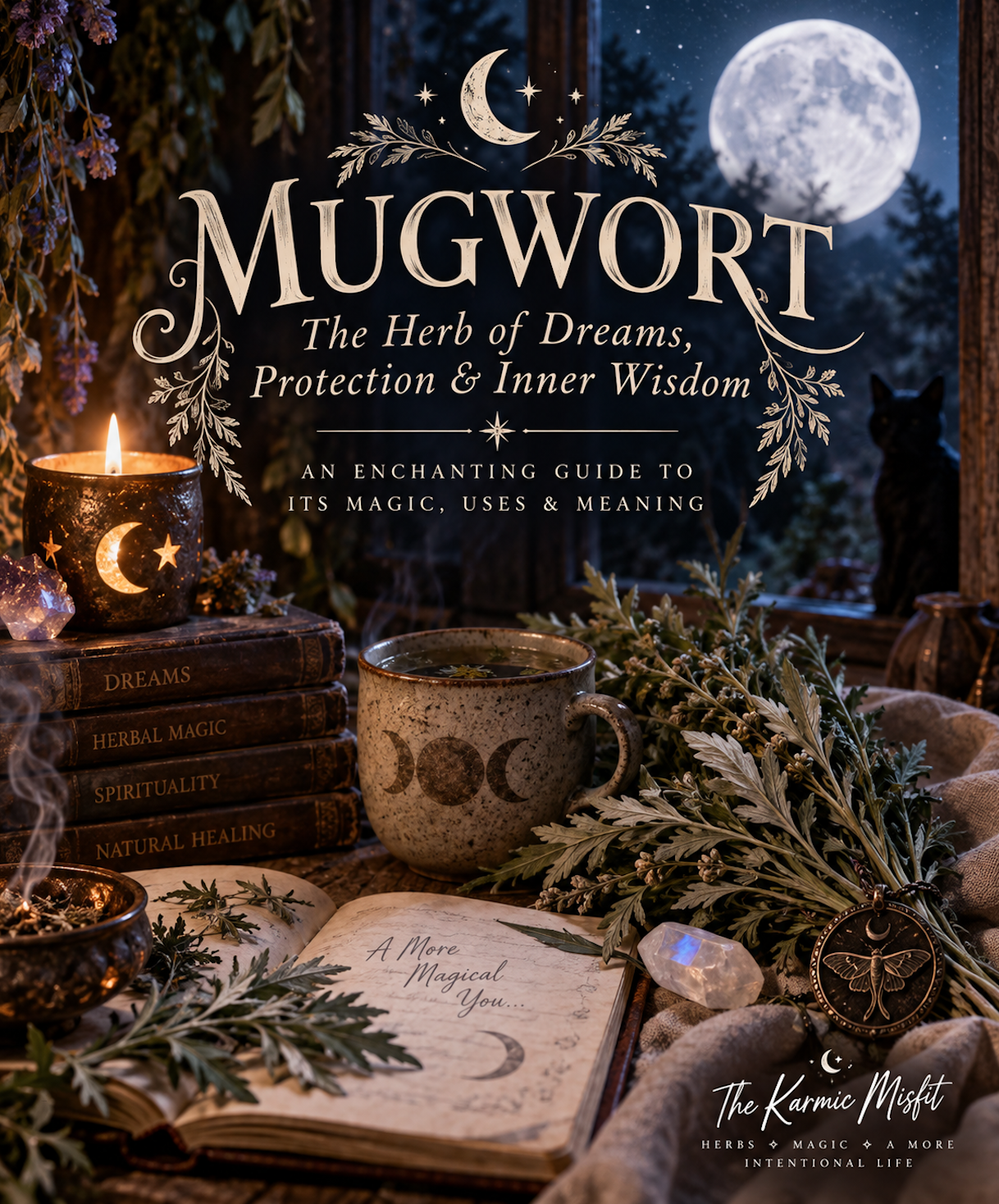
Mugwort is one of those herbs that seem to live comfortably in two worlds at once. On one hand, it is a hardy, almost stubborn plant that can grow along roadsides, fields, gardens, and forgotten edges of the landscape. On the other, it has spent centuries wrapped in folklore, herbal tradition, dreamwork, protection, intuition, and the kinds of stories that make you want to keep reading long after you originally meant to stop.
Part of mugwort’s appeal comes from the fact that it has never really been just one thing. Historically, different cultures have used varieties of mugwort in traditional herbal practices, food, ritual, protection work, and seasonal customs. Over time, it also became closely associated with dreams, divination, the moon, spiritual awareness, and those strange in-between moments when the ordinary world feels just a little less ordinary.
Today, mugwort has found its way back into modern herbalism and spiritual practices, often appearing in dream pillows, incense blends, ritual bundles, meditation spaces, and discussions about vivid dreams or intuition. As with many herbs that carry a long magical reputation, though, some of the claims surrounding mugwort have become exaggerated along the way. Not every experience is going to be dramatic, prophetic, or mystical, and there is value in understanding the history and symbolism without turning the plant into something it was never meant to be.
In this Herb Spotlight, we are going to look at mugwort from several angles, including its botanical background, historical uses, folklore, spiritual correspondences, dream associations, practical ways to work with it, and important safety considerations. Whether you are drawn to mugwort because of its reputation as a dream herb, its long history in folk traditions, or simply because you enjoy learning about plants with unusually rich stories, this is one herb with plenty of layers to uncover.
And considering mugwort has a habit of spreading wherever it pleases, it seems only fitting that its history has done the same.
What is Mugwort?

Mugwort is a common name used for several plants in the Artemisia genus, but the species most often meant by “mugwort” is Artemisia vulgaris. It belongs to the Asteraceae family, the same broad plant family that includes daisies, sunflowers, chamomile, and ragweed. That family connection is worth remembering later, especially when we get into allergy and safety considerations.
At first glance, mugwort can look fairly ordinary. It usually grows tall and upright, with deeply divided green leaves that often have a silvery or whitish underside. When the leaves are crushed, they release a strong herbal scent that can be described as earthy, slightly bitter, and almost sage-like. In late summer, mugwort produces clusters of small, rather understated flowers instead of the large, showy blooms people may expect from other members of the daisy family.
One reason mugwort has become so widespread is that it is an incredibly hardy plant. It can grow in disturbed soil, along roadsides, at the edges of fields, near fences, and in places where many more delicate herbs would struggle. Once established, it spreads through underground rhizomes and can be surprisingly difficult to remove. In other words, mugwort does not exactly wait politely for permission before moving into a new neighborhood.
A Few Quick Mugwort Facts
- Botanical name: Artemisia vulgaris
- Plant family: Asteraceae
- Common names: Mugwort, common mugwort, wild wormwood
- Plant type: Perennial herb
- Typical appearance: Tall stems with deeply divided leaves and pale, silvery undersides
- Aroma: Strong, herbal, earthy, and slightly bitter
- Growing habit: Extremely hardy and capable of spreading aggressively
- Common habitat: Roadsides, fields, waste ground, garden edges, and disturbed soil
Mugwort is also closely related to other well-known Artemisia species, including wormwood (Artemisia absinthium) and sweet wormwood (Artemisia annua). These plants share some similarities, but they are not interchangeable, especially when it comes to traditional uses, chemistry, and safety. That is one reason it is important to identify the exact species rather than assuming anything labeled “Artemisia” is simply another form of mugwort.
The genus name Artemisia has long been associated with Artemis, the Greek goddess connected with wilderness, childbirth, and the moon, although the exact origin of the botanical name is debated. That connection has undoubtedly helped strengthen mugwort’s modern reputation as a lunar and intuitive herb, but its symbolic associations developed through many different cultures and traditions rather than from one single source.
Before mugwort became a favorite in modern dreamwork and spiritual circles, it was simply useful, resilient plant with a long relationship to people. Its ability to thrive almost anywhere may be part of what made it so easy to weave into food, folk medicine, protection customs, and eventually ritual practice.
A Herb Wrapped in History

Mugwort’s reputation did not appear overnight. Long before it became associated with dream pillows, moon rituals, and modern spiritual practice, it had already earned a place in folk medicine, household traditions, travel customs, and seasonal celebrations across different parts of Europe and Asia.
In Europe, mugwort was often treated as a protective herb. It was carried by travelers, tucked into clothing, hung in homes, and used in folk practices meant to guard against misfortune, fatigue, or unwanted influences. One of the most persistent traditions connected mugwort with journeys, which helped give it a reputation as an herb of safe passage and protection on the road.
Mugwort also appeared in old herbal preparations and traditional remedies. Historically, it was used in ways connected with digestion, menstrual complaints, warmth, and general vitality, although those uses should be understood as part of traditional practice rather than modern medical guidance. As with many herbs, historical use tells us a great deal about how people understood the plant, but it does not automatically mean every old remedy was safe or effective.
Mugwort in Folk Tradition
Across different regions and time periods, mugwort became associated with several recurring themes:
- protection during travel
- cleansing and purification
- strength and endurance
- seasonal festivals
- women’s health and reproductive traditions
- divination and spiritual awareness
- protection of the home
- dreams and altered states of awareness
One particularly interesting piece of mugwort folklore comes from old midsummer traditions. In parts of Europe, mugwort was gathered around the summer solstice and used in protective garlands, belts, or wreaths. Some traditions involved wearing mugwort during celebrations and later throwing it into a fire as a symbolic way of releasing illness, bad luck, or unwanted energy.
Mugwort also became connected with St. John’s Eve and other midsummer customs after older folk practices blended with Christian traditions. This kind of layering is common in herbal folklore. One plant could carry pagan associations, household uses, Christian symbolism, and practical medicinal traditions all at the same time.
In parts of Asia, related mugwort species have also held an important place in traditional practices. Mugwort has been used in food, seasonal customs, and forms of traditional medicine, including moxibustion, where dried mugwort is burned near specific points of the body. These traditions developed separately from European folk magic, which is important to keep in mind when talking about mugwort as though it has one single spiritual history.
What makes mugwort especially interesting is that many of its old associations seem to circle around thresholds: travel, seasonal changes, dreams, protection, healing, and moments when someone is moving from one state into another. That may be part of the reason it eventually became known as such a strongly liminal herb.
Mugwort has always seemed to belong at the edges a little, growing in neglected places while collecting stories about journeys, spirits, dreams, protection, and change. For an herb that often thrives along roadsides and boundaries, that symbolism feels strangely fitting.
Mugwort and the World of Dreams

Of all the associations surrounding mugwort, its connection with dreams is probably the one that has captured the most modern attention. The herb is frequently linked with vivid dreaming, dream recall, intuition, and the idea of becoming more aware of what is happening beneath the surface of the conscious mind.
In folk and spiritual traditions, mugwort has often been used before sleep or during divination practices as a way of encouraging a more receptive state of mind. Some people place dried mugwort in dream pillows, keep it near the bed, or incorporate it into meditation and journaling rituals before going to sleep. The intention is usually not to “force” a particular kind of dream, but rather to create a ritual atmosphere that encourages reflection, awareness, and attention to what comes through during the night.
That distinction is important, because mugwort has picked up quite the reputation online. It is sometimes presented as though using it will automatically create prophetic dreams, lucid dreaming, or dramatic spiritual experiences. In reality, dream experiences vary greatly from person to person, and there is no guarantee that mugwort will produce any particular result.
Why Is Mugwort So Closely Linked With Dreams?
There are several reasons this association has lasted:
- its long history in folk magic and divination
- its traditional connection with intuition and spiritual awareness
- its association with the moon and nighttime practices
- its use in ritual settings meant to encourage reflection
- the simple fact that generations of people have continued to pass down stories about it
For many people, the ritual itself may be part of what makes the experience meaningful. Setting an intention before sleep, keeping a dream journal nearby, dimming the lights, and creating a quiet environment can naturally make someone pay closer attention to their dreams. Mugwort often becomes part of that larger practice rather than acting as a magical switch all on its own.
Dreamwork With Mugwort
If someone chooses to include mugwort in a dream practice, there are gentle ways to work with it that do not involve ingesting the herb. A small amount of dried mugwort can be placed inside a sealed dream sachet or pillow, kept near a journal, or used as part of a bedtime altar or mediation space.
A simple dreamwork practice might include:
- setting a clear intention before bed
- writing down a question or theme you want to reflect on
- keeping mugwort nearby as a symbolic reminder
- recording any dreams as soon as you wake up
- looking for recurring symbols or emotions rather than trying to force a literal interpretation
Dreams can be strange, symbolic, emotional, or completley random, and not every dream needs to be treated as a message from somewhere beyond us. Sometimes they reflect stress, memory, imagination, or the mind sorting through the day. Other times, they may feel unusually meaningful. Mugwort’s place in dreamwork is less about proving where a dream came from and more about encouraging curiosity toward what rises to the surface.
That may be why the herb has remained so strongly connected with the dream world. Mugwort does not need to guarantee a vision or a prophecy to be useful. Sometimes its role is simple to mark the moment when we become quiet enough to listen.
Protection, Cleansing & Spiritual Boundaries

Mugwort’s history is not only tied to dreams and divination. It has also long been associated with protection, cleansing, and the idea of creating a boundary between yourself and whatever you do not want to carry with you. In folk traditions, that could mean anything from bad luck and illness to unwanted spiritual influences or simply the exhaustion that came with travel.
Because of those associations, mugwort was sometimes worn, carried, hung near entrances, or included in protective charms. Travelers were known to keep it with them, while household traditions used it near doors or other thresholds. The symbolism makes sense when you think about where mugwort naturally grows: along roadsides, fences, field edges, and other places that exist between one space and another.
In modern spiritual practice, mugwort is often used in a similar symbolic way. Rather than treating it as a guaranteed shield against anything unseen, many people work with it as a reminder to be intentional about what they allow into their space and what they are ready to release.
Ways Mugwort Is Commonly Used for Protection
Mugwort may be incorporated into spiritual or household practices in several ways:
- placed in a small protective sachet near a doorway
- added to an altar focused on protection or intuition
- kept with travel items as a symbolic herb of safe passage
- included in dried herb bundles or ritual arrangements
- used alongside journaling or meditation when setting personal boundaries
- combined with other protective herbs in a charm or bowl
Some people also burn mugwort as incense or use it in smoke-based cleansing practices. If you choose to work with it this way, ventilation matters, and smoke should never be assumed to be harmless simply because it comes from an herb. People with asthma, respiratory sensitivities, pets, or young children in the home may prefer smoke-free options such as sachets, bowls of dried herbs, or symbolic altar use instead.
Protection Does Not Always Have to Mean Something Dramatic
One of the things I like about mugwort is that protection does not have to be a framed as a battle against something dark and threatening. Sometimes protection looks much more ordinary. It can mean recognizing when you are overstimulated, limiting access to your energy, stepping away from environments that leave you drained, or creating a home that feels calm and intentional.
That makes mugwort a fitting herb for spiritual boundaries as much as spiritual protection. Its symbolism can be used as a reminder that intuition is not only about receiving messages or noticing signs. Sometimes intuition is simply recognizing when something feels off, when enough is enough, or when you need to protect your own peace.
Mugwort’s protective reputation has survived for centuries because it has always been connected with thresholds: the doorway, the road, the transition, and the space between what yo are leaving behind and what you are moving toward. Whether you view that symbolically, spiritually, or somewhere in between, it is easy to see why mugwort became such a powerful boundary herb.
Mugwort and the Moon

Mugwort’s connection with the moon is one of the reasons it feels so at home in modern spiritual practice. The herb is often associated with intuition, dreams, cycles, the subconscious, and the quieter parts of ourselves that tend to become more noticeable when everything else settles down. Because of that, mugwort is frequently paired with lunar rituals, especially practices centered around reflection, release, intention-setting, or dreamwork.
Part of this connection comes from symbolism. The moon has long been linked with change, rhythm, mystery, and inner awareness, while mugwort has carried many of those same themes through folklore and ritual tradition. Its silvery leaf undersides also give it a naturally lunar appearance, which only strengthens the association.
Working With Mugwort Through the Moon Cycle
Some people choose to work with mugwort differently depending on the phase of the moon:
- New Moon: intention-setting, inner reflection, and deciding what you want to begin
- Waxing Moon: building confidence, strengthening intuition, and supporting growth
- Full Moon: dreamwork, divination, emotional awareness, and releasing what has reached its peak
- Waning Moon: cleansing, boundary work, letting go, and clearing out stagnant energy
There is no single rule saying mugwort “belongs” to one moon phase more than another. Like most spiritual correspondences, these associations can vary depending on tradition and personal practice. The goal is less about following a rigid formula and more about using the herb in a way that supports the intention behind the ritual.
Mugwort also pairs naturally with moon journaling. Keeping a small sachet nearby while writing about emotional patterns, dreams, recurring thoughts, or changes happening in your life can turn an ordinary journaling session into something more deliberate. Even if you view the practice symbolically rather than magically, creating that kind of ritual space can make it easier to slow down and notice what has been sitting quietly in the background.
A Herb for Cycles and Change
The moon is constantly changing, even when its movement is so gradual that we barely notice it. Mugwort carries a similar symbolism because so much of its history revolves around transition, thresholds, protection, and awareness.
That makes it especially fitting for times when life feels uncertain or when you know something is shifting but you cannot quite name what yet. Mugwort does not have to provide an answer. Sometimes its role is simply to encourage reflection while you move through the change.
For that reason, its lunar reputation feels less like a random correspondence and more like an extension of everything mugwort has represented for centuries: dreams, boundaries, intuition, movement, and the quiet spaces where change begins.
Traditional Herbal Uses

Long before mugwort became popular in modern spiritual circles, it was used in traditional herbal practices across different parts of Europe and Asia. Its reputation as a medicinal herb developed over centuries, although the way it was used varied depending on region, culture, and the species of Artemsisia involved.
Historically, mugwort was often connected with digestion, menstrual discomfort, circulation, and general warning or stimulation preparations. It was also used in traditional practices involving childbirth and reproductive health, which is one reason mugwort deserves a little more caution than some everyday culinary herbs.
Some Traditional Uses Included
- supporting digestion after heavy meals
- ease certain menstrual complaints
- use in warming herbal preparations
- inclusions in baths, poultices, and infused oils
- use in traditional practices related to circulation
- incorporation into regional food and medicinal traditions
Mugwort also has a long history of East Asian medicine through practices such as moxibustion. In moxibustion, dried mugwort is burned near specific points on the body as part of a traditional therapeutic system. This is different from casually burning mugwort as incense and generally performed within established medical traditions by trained practitioners.
As interesting as mugwort’s medicinal history is, historical use should not be treated as proof that every traditional remedy is safe or effective. Herbal medicine can still cause side effects, interact with medications, trigger allergies, or be inappropriate for certain people. Mugwort in particular is one herb I would not treat casually simply because it is “natural.”
A Note About Internal Use
Mugwort is sometimes sold in teas, tinctures, capsules, or other herbal preparations, but internal use is not something everyone should experiment with on their own. Pregnancy is a major caution because mugwort has historically been associated with stimulating menstruation and uterine activity. People who are pregnant or trying to become pregnant should avoid internal mugwort unless specifically advised otherwise by a qualified healthcare professional.
People with allergies to plants in the Asteraceae family, including ragweed, daisies, chrysanthemums, or chamomile, may also be more likely to react to mugwort. Anyone taking medications or managing a health condition should check with a qualified healthcare professional before using it medicinally.
For spiritual or symbolic purposes, there is usually no need to ingest mugwort at all. Sachets, altar use, journaling rituals, dried arrangements, and other non-ingested practices can still carry all of the symbolism without turning a spiritual herb into an unnecessary health experiment.
Mugwort’s medicinal history is part of what makes the plant so fascinating, but it is also a good reminder that herbs can be both useful and powerful. Respecting the plant includes knowing when not to use it.
I care about you all and would like everyone to be safe.
Ways to Work With Mugwort

Mugwort is one of those herbs that can be worked with in many different ways without needing to make the practice complicated. Because so much of its symbolism is tied to dreams, intuition, protection, and transition, it fits naturally into small rituals and everyday spiritual routines.
You also do not need to ingest it to make use of its symbolism. For many people, dried mugwort used in sachets, altar work, journaling spaces, or ritual arrangements is more than enough.
Simple Ways to Use Mugwort
- Dream sachets: Place a small amount of dried mugwort into a fabric sachet and keep it near your bed or journal.
- Altar work: Add dried mugwort to an altar focused on intuition, protection, dreamwork, or lunar energy.
- Protection charms: Combine mugwort with other protective herbs, and keep the bundle near an entryway, workspace, or travel bag.
- Meditation: Keep mugwort nearby while meditating on intuition, boundaries, or personal transitions.
- Journaling rituals: Place it beside your journal when reflecting on dreams, emotional patterns, or spiritual shifts.
- Lunar rituals: Incorporate mugwort into New Moon, Full Moon, or release rituals as a symbol of reflection and inner awareness.
- Dried arrangements: Use mugwort in a small botanical bundle or bowl as a decorative and symbolic element.
- Smoke-free cleansing: Instead of burning the herb, place it in a sachet or bowl and use it as a physical reminder of the intention to clear and protect a space.
Mugwort in Dreamwork
One of the easiest ways to begin working with mugwort is through a dream practice. A small sachet near the bed, paired with a notebook and a clear intention before sleep, can create a simple ritual around dream recall.
The intention does not have to be dramatic. Sometimes a protective practice can be as simple as reminding yourself that not everything deserves access to your time, attention, or energy.
Mugwort in Ritual Spaces
Because of its long association with liminal spaces, mugwort works especially well in rituals connected with endings, beginnings, uncertainty, and change. It can be added to an altar, placed beside a candle, or included in a seasonal arrangement as a symbol of moving from one chapter to another.
Mugwort is not an herb that needs elaborate ceremony. In many ways, its strength comes from how easily it can be woven into small, intentional practices. A little goes a long way, especially when the purpose of the ritual is simply to slow down, pay attention, and listen more closely to what is already stirring beneath the surface.
Mugwort Correspondences

Mugwort has collected a long list of spiritual correspondences over the years, especially in modern folk magic, witchcraft, and intuitive practices. As with most herb correspondences, these are not universal rules. Different traditions may connect mugwort with different planets, elements, deities, or intentions.
Still, a few themes appear again and again.
Common Mugwort Correspondences
- Element: Air, sometimes Earth
- Planet: Moon
- Chakras: Third Eye and Crown
- Primary associations: Intuition, dreams, protection, divination, cleansing, spiritual awareness, boundaries, and transition
- Colors: Silver, white, gray, deep green, and purple
- Best suited for: Dreamwork, meditation, lunar rituals, protection work, journaling, and spiritual reflection
Crystals That Pair Well With Mugwort
Mugwort can be paired with crystals that support similar intentions:
- Amethyst for intuition, dreamwork, and spiritual reflection
- Moonstone for lunar energy, cycles, and emotional awareness
- Labradorite for protection, transformation, and intuitive work
- Clear Quartz for clarity and amplifying intention
- Smoky Quartz for grounding and boundaries
- Obsidian for protection and deeper shadow work
Herbs That Pair Well With Mugwort
Depending on your intention, mugwort can also be combined with other herbs:
- Lavender for peaceful sleep and calming dreamwork
- Rosemary for protection and cleansing
- Bay Laurel for intuition, wishes, and divination
- Chamomile for relaxation and gentle sleep rituals
- Sage for cleansing and spiritual protection
- Yarrow for boundaries, courage, and protection
There is no need to use every correspondence at once. In fact, a simpler combination is often easier to work with because the intention stays clear. Mugwort paired with lavender for dreamwork feels very different from mugwort paired with rosemary and smoky quartz for protection.
The correspondences are really just a framework. They can help you build a ritual or create symbolism around an intention, but the meaning you personally attach to the herb still matters as much as any traditional list.
A Simple Mugwort Dream Ritual
A mugwort dream ritual does not need to be elaborate. The goal is simply to create a quiet moment before sleep, set an intention, and give yourself a better chance of remembering whatever comes through during the night.
For this ritual, you can keep mugwort nearby rather than ingesting or burning it. A small dream sachet is enough.
What You’ll Need
- a small amount of dried mugwort
- a small cloth sachet or pouch
- a journal and pen
- a candle, if you like using one during rituals
- optional additions such as lavender, amethyst, or moonstone
Before Bed
Place a small amount of dried mugwort inside the sachet. If you want a calmer feel, you can add a little lavender as well. Keep the pouch near your bed or beside your journal rather than directly against your face.
Spend a few quiet minutes thinking about what you want to pay attention to that night. You can ask for clarity around a situation, focus on remembering your dreams more clearly, or simply stay open to whatever your mind brings forward.
Write your intention in your journal before going to sleep. Keeping it simple usually works best. Something like, “Tonight I want to remember what feels important,” is enough.
If you are using a candle, let it burn only while you are awake and present. Extinguish it fully before going to sleep. (It’s a legitimate fear of mine.)
When You Wake Up
Try not to reach for your phone immediately. Give yourself a moment to remember any details from the night, even if they seem random.
Write down whatever you can remember, including:
- people or animals that appeared
- places or landscapes
- colors, objects, or symbols
- emotions you felt
- anything that repeated
- anything that seemed unusually vivid
You do not have to interpret everything right away. Sometimes a dream makes more sense after you have had time to sit with it, and sometimes a strange dream is simply a strange dream.
Over time, keeping a consistent dream journal can make recurring themes easier to notice. Mugwort can become part of that routine as a symbolic reminder to slow down, pay attention, and remain curious about what your subconscious may be working through.
The ritual itself is not about forcing a mystical experience. It is about creating enough quiet and intention that you are more likely to notice the experiences you are already having.
Important Mugwort Safety Notes

Mugwort has a long history in herbal and spiritual practice, but that does not mean it is automatically safe for everyone. Like any herb, it can cause unwanted reactions, and some forms of use carry more risk than others.
For most people using mugwort symbolically in sachets, altar work, or decorative arrangements, the concerns are fairly limited. Internal use, smoke exposure, pregnancy, and allergies require more caution.
Mugwort May Not Be Appropriate If You:
- are pregnant or trying to become pregnant
- have allergies to ragweed, daises, chrysanthemums, chamomile, or other plants in the Asteraceae family
- have asthma or are sensitive to smoke
- take medications that could interact with herbal products
- have an insisting medical condition and are considering medicinal use
I know I may sound like one of those drug advertisements with a forever list of cautions and side effects, but your health is more magical than the herb itself.
Mugwort has historically been used in connection with menstruation and uterine stimulation, which is why internal use during pregnancy is generally avoided unless a qualified healthcare professional specifically advises otherwise.
Allergic reactions are another important consideration. Because mugwort belongs to the same plant family as ragweed, some people who react strongly to ragweed or similar plants may also react to mugwort.
Be Careful With Burning Mugwort
Mugwort is sometimes burned as incense or used in smoke-based cleansing practices, but herbal smoke can still irritate the lungs and airways. Good ventilation matters, and people with asthma, respiratory sensitivities, young children, or pets in the home may prefer smoke-free alternatives.
Sachets, dried herb bowls, altar arrangements, and symbolic use can offer the same spiritual intention without filling a room with smoke.
More Is Not Always Better
Mugwort has a reputation for being a powerful herb, which can sometimes lead people to assume that using more will create a stronger spiritual or dream experience. That is not necessarily true.
With dreamwork especially, a small amount used as part of a quiet bedtime ritual is more than enough. There is no need to over-complicate the practice or push yourself toward an intense experience.
The same rules applies to herbs in general: respect the plant, learn how it has traditionally been used, and do not confuse “natural” with “risk-free.”
Mugwort can be a beautiful addition to spiritual practice, but part of working with any herb responsibly is knowing when to use it gently, when to avoid it, and when to ask a qualified professional for guidance.
Closing: The Herb Between Worlds
Mugwort has earned its mysterious reputation honestly. It has spend centuries appearing in folk traditions, herbal practices, protective customs, dreamwork, and spiritual rituals, all while growing quietly along roadsides and forgotten edges as though it has no idea how much symbolism people have attached to it.
What makes mugwort so interesting is that it does not belong neatly to just one category. It is practical and symbolic, ordinary and strange, grounded in the physical world while constantly being associated with dreams, intuition, thresholds, and things that are harder to explain. That contrast is part of what has kept people fascinated by it for so long.
Whether you work with mugwort spiritually, appreciate it for its history, or simply enjoy learning about herbs with a little mystery behind them, there is plenty to explore without turning it into something it is not. It does not need to guarantee prophetic dreams or mystical experience to be meaningful.
For me, mugwort feels like an herb of awareness. It encourages us to pay attention to the things we usually rush past: our dreams, our instincts, our boundaries, the transitions we are moving through, and the quieter parts of ourselves that tend to speak when everything else finally settles down.
And maybe that is the real magic of mugwort. Not that it opens some secret doorway for us, but that it reminds us to notice the doors that were already there.

Leave a Reply