Every year, one particular date returns to us carrying a meaning no other day can quite hold. It may arrive with candles, cake, gifts, laughter, and familiar traditions, but beneath the celebration is something older, stranger, and far more magical than most of us realize. A birthday is not simply the day we become another year older. It marks the anniversary of our arrival into the world, the closing of one personal cycle, and the beginning of another.
Long before birthday parties looked the way they do today, the day of a person’s birth was surrounded by beliefs about fate, protection, spirits, divine influence, and the mysterious power of time. In some traditions, birthdays were reserved for rulers and the wealthy. In others, the birthday person was believed to be especially vulnerable to unseen forces and needed to be surrounded by family, light, noise, food, and well-wishes for protection. Candles were not always simple decorations, gifts were more than pleasant surprises, and the wish made before blowing out the flames carried the quiet feeling of a spell.
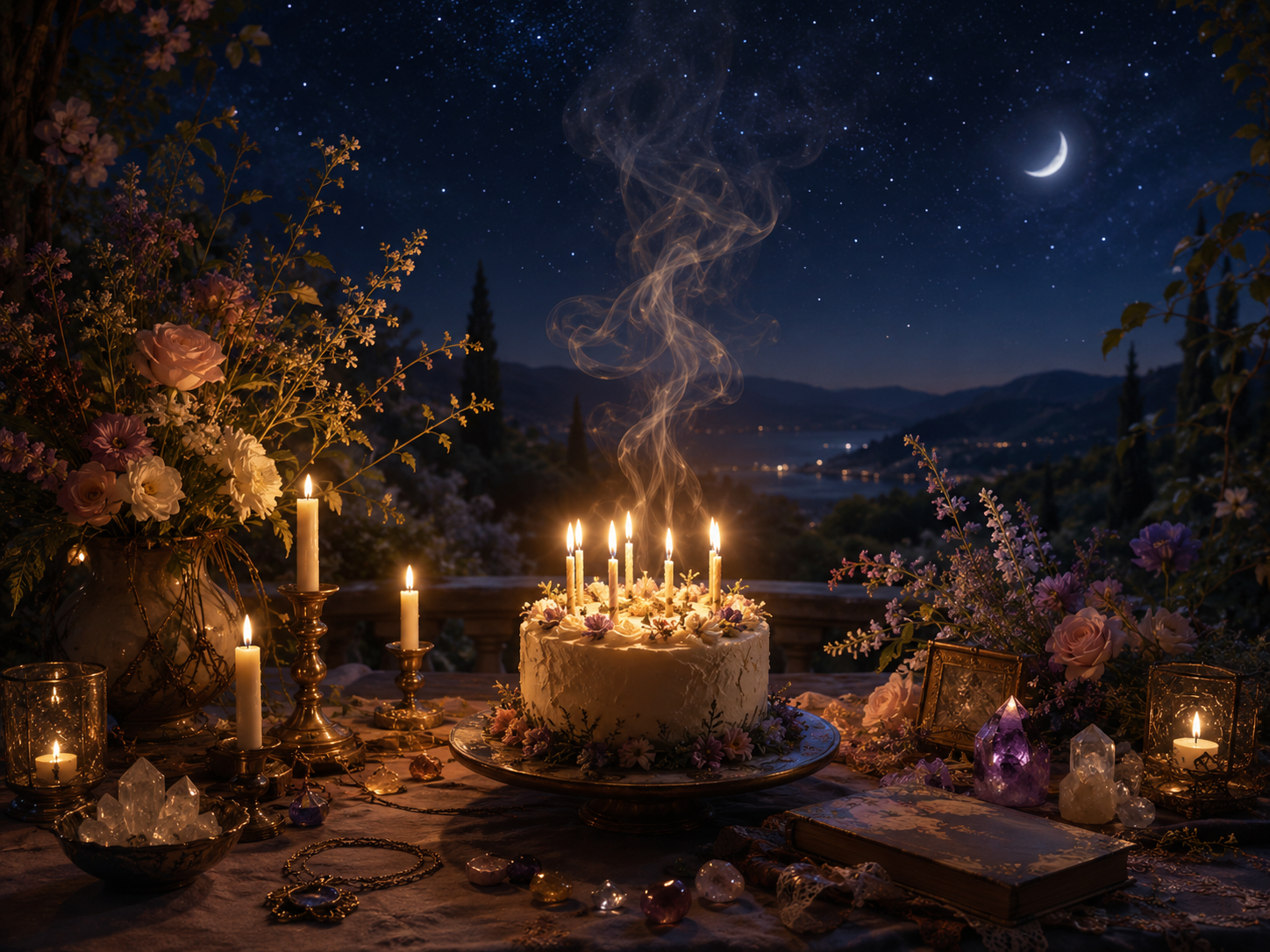
Even now, traces of those ancient customs remain woven into the celebration. We gather in a circle. We light small flames. We sing a person’s name together. We offer sweet food, tokens of affection, and wishes for happiness, health, and many more years to come. Then, for a few quiet seconds, the birthday person closes their eyes, holds a private desire in their heart, and releases it into the rising smoke.
Birthdays can feel joyful, emotional, reflective, or even a little unsettling. They remind us that time is moving, yet they also invite us to pause and recognize how far we have traveled. They are personal new years, spiritual thresholds, and reminders that our presence in this world is worthy of being witnessed.
Behind the familiar cake and candles lives a celebration filled with ancient history, folklore, myths, superstitions, and magic. To understand the birthday is to look beyond the party and into the centuries of belief that still flicker quietly beneath every flame.
Before Birthdays Belonged to Everyone

The earliest birthday celebrations looked very different from the cheerful parties we know today. There were no brightly wrapped gifts, frosted cakes, or candles waiting to be blown out. In many ancient societies, an ordinary person’s exact date of birth may not have been recorded at all. Calendars were often tied to agriculture, religion, royal rule, and the movements of the heavens, and the birthdays most likely to be remembered belonged to kings, rulers, gods, and other figures believed to carry special importance.
Ancient Egypt is often mentioned when tracing the beginnings of birthday celebrations, although the story is more complicated than it first appears. The occasions recorded in ancient texts may not always have celebrated the physical day a pharaoh was born. Instead, they were sometimes connected to coronation, accession, or the moment a ruler was transformed into a sacred and almost divine figure. In the eyes of the people, this was a second birth: the day an ordinary human identity was left behind a royal, a spiritual one began.
This makes the ancient meaning of a birthday especially fascinating. It was not always about age. It was about transformation.
A ruler’s ceremonial “birth” marked the crossing from one state of existence into another. The person they had been was no longer quite the same as the person they had become. That idea still lingers in the way birthdays can feel today. Even when nothing visible changes overnight, the date creates a dividing line between the year behind us and the year ahead. One chapter closes, and another begins before we know what it will contain.
Ancient cultures also paid careful attention to the character on particular days. Time was not always viewed as an empty stretch of identical hours. Certain dates could be fortunate, dangerous, sacred, or connected to the actions of gods and spirits. The day a person’s birth might therefore reveal something about the forces surrounding their arrival, including the season, the sky, religious festivals, or omens believed to shape their fate.
To be born on a certain day was to enter the world beneath a particular pattern. The sun stood in one place. The moon carried a certain face. The sessions were turning in their own direction. Whether people looked to gods, stars, rulers, or the natural world, birth was rarely seen as a meaningless accident of the calendar. It happened within a living universe, and the date became part of the story.
For many centuries, however, the privilege of marking that story belonged mostly to the powerful. Kings and nobles had the resources to record their births, hold feasts, commission offerings, and gather large groups of people in their honor. The lives of ordinary farmers, laborers, servants, and villagers were less likely to be documented in the same way. Their births mattered deeply to their families, but they did not always become official anniversaries.
Over time, birthday customs slowly traveled beyond palaces, temples, and royal courts. The celebration became more personal, more domestic, and eventually more widely shared. What began as an observance of divine favor, royal power, and sacred transformation gradually became a way of honoring the existence of everyday people. That shift carried its own quiet magic.
A day once reserved for those believed to be chosen by gods became a day when almost anyone could be treated as worthy of ceremony. For a few hours, one person could stand at the center of the circle, receive blessings, and be reminded that their arrival into the world was important enough to remember.
The Greeks, the Moon, and Cakes of Light

One of the most enchanting stories connected to the history of birthdays leads us into ancient Greece, where offerings of food, flame, and fragrance were used to honor the gods. Among the most beloved figures in Greek religion was Artemis, goddess of the wilderness, the hunt, childbirth, young women, and the moon. Her presence was connected to the untamed world, the protection of life, and the silver light that watched over the night.
worshipers brought cakes and other offerings to sacred places in her honor. Some of these cakes were round or shaped to resemble the moon, creating a beautiful reflection of the goddess they were meant to please. Later stories describe small flames placed upon the cakes so they glowed like the moon itself. The light, the rounded shape, and the rising smoke formed a symbolic offering that could be seen by both the human and divine worlds.
It is tempting to imagine these moonlit cakes as the direct ancestors of the modern birthday cake. The true history is not quite that simple, and there is no perfectly unbroken path from an ancient temple offering to the candles we place on cakes today. Customs travel, disappear, return, and change as they pass through different cultures and centuries. Still, the similarities are striking enough to feel almost haunting.
A round cake sits at the center of a gathering. Small flames burn upon its surface. A wish or prayer is held close. Then the smoke rises toward something unseen.
In ancient ritual, smoke often served as a bridge between worlds. Incense, herbs, oils, food, and other offerings were burned so their essence could rise toward the gods. What could no longer be touched was believed to have entered another realm. Fire transformed the offering, while smoke carried its message upward.
This symbolism gives birthday candles a deeper and more mystical meaning. Before candles became cheerful decorations, flame already represented life, protection, divine presence, and communication with the sacred. A candle could illuminate darkness, mark a holy space, guide a spirit, or hold the focus of a prayer.
The moon-shaped cakes of Artemis also remind us that celebration was once inseparable from the heavens. The sky was not merely a backdrop to human life. The sun, moon, planets, and stars were living symbols, divine bodies, and markers of sacred time. Their movements shaped festivals, planting seasons, journeys, omens, and the stories people told about their place in the universe.
A birthday carries the same celestial quality. It is the anniversary of the day a person entered the world beneath a particular sky. The moon held one phase. The sun stood in one place. The stars formed a pattern overhead, whether visible or hidden by daylight. To celebrate that date is, in a way, to remember the sky that witnessed the beginning. The moon has always been linked with cycles, and a birthday is a cycle of its own.
It returns year after year, familiar yet never exactly the same. We come back to the same date, but we are changed each time we meet it. Like the moon, we move through phases of fullness, darkness, growth, release, and renewal.
Perhaps that is why candles and round cakes still feel so natural at the center of a birthday celebration. Their shapes and light speak a language older than the party itself. The cake becomes a small moon placed before us, while the flames glow like stars gathered close enough to touch.
For a few quiet moments, the ordinary room becomes something else. The lights dim. The voices soften. Everyone turns toward the flame. The birthday person stands between one year and the next, illuminated by a circle of living light. And although the setting may be a kitchen, dining room, or backyard instead of an ancient temple, the moment still carries the feeling of an offering.
Roman Birthdays and the Spirit That Walked Beside You

By the time birthday customs appeared more clearly in Ancient Rome, the celebration had begun to move away from temples and royal courts and into the home. A birthday could be marked with food, wine, flowers, gifts, prayers, and gatherings of family and friends. The day was still more commonly celebrated among men of status and influence, but it had become recognizably personal. It honored not only power or position, but the life of an individual.
The Romans called a birthday the dies natalis, meaning the day of birth. The phrase could also be used for the anniversary of a temple, city, organization, or important event. In the Roman imagination, anything with a meaningful beginning could possess a birthday. A structure, community, or sacred place could be remembered in much the same way as a person, because its beginning marked the moment it entered the world and became part of history. This reveals something beautiful about the ancient understanding of birth. A beginning was not forgotten once it had passed. It remained worthy of return.
On a person’s birthday, offerings might be made at the household shrine, where the family honored the spirits and divine powers believed to protect the home. Among these was the genius, a spiritual presence connected to a man’s identity, vitality, fate, and ability to create life. Women were often associated with a similar protective force connected to the goddess Juno.
The Roman genius was not quite the same as the guardian angel many people imagine today. It was closer to a personal divine essence, and unseen companion tied to the individual from birth. It represented the spark of life within them and the force that helped shape who they are becoming. On a birthday, this spirit could be honored alongside the person.
Wine might be poured. Incense could be burned. Flowers, cakes, or other offerings might be placed before the household shrine. The celebration acknowledged that a human life was more than what could be seen. Behind the body and personality lived a mysterious force that had traveled beside the person since the beginning. The birthday therefore became an act of gratitude.
It thanked the gods and spirits for another year off protection. It honored the life force that had survived illness, hardship, danger, and uncertainty. It asked for continued favor as the person entered the year ahead.
This ancient belief gives another meaning to the way we celebrate birthdays now. When we tell someone we are grateful they were born, we are recognizing more than their age. We are honoring the unique energy they bring into the world: the way they speak, love, create, laugh, struggle, heal, and leave their mark upon the people around them.
The Romans also believed strongly in omens and signs. The events surrounding an important day could be interpreted as messages about what was to come. A birthday may have carried special weight because it returned the person to the anniversary of their first breath, placing them once again near the mysterious conditions that shaped their fate. The day could then be approached with both celebration and care.
Good words mattered. Offerings mattered. The presence of loved ones mattered. A birthday was a time to strengthen the person’s connection to protection, luck, and the divine forces believed to accompany them.
Garlands and flowers may have decorated the space. Guests could bring gifts or food. Prayers were spoken for health, prosperity, and long life. The gathering created an atmosphere of abundance around the person, as though everyone present were adding their own blessing to the coming year.
The Romans understood that a person did not move through life entirely alone. Family, ancestors, household spirits, gods, and unseen forces all belonged to the story. A birthday gathered these visible and invisible relationships together.
At the center stood the person whose life was being honored. Around them stood the people who loved them. And beside them, whether anyone could see it or not, walked the spirit that had been there since they day they were born.
When Birthdays Were Considered Spiritually Dangerous

Birthdays have not always been viewed as entirely cheerful occasions. Beneath the feasting, gifts, and well-wishes lived an older and more unsettling belief: the anniversary of a person’s birth could leave them especially vulnerable to unseen forces.
This idea was not unique to birthdays. In folklore, moments of transition were often treated with caution because they belonged fully to neither one state not the next. Doorways, crossroads, dawn, dusk, weddings, childbirth, seasonal changes, and the turning of the year were all believed to hold unusual power. They were liminal space, suspended between what had ended and what had not yet fully begun.
A birthday carries the same quality. For a brief moment, a person stands between ages. One personal year has closed, but the next has only just opened. Symbolically, the old self has been left behind while the new year remains unwritten. This made the birthday a powerful threshold, but power and vulnerability were often believed to travel together.
Some traditions held that spirits were drawn to celebrations, especially those filled with noise, food, flame, and strong emotion. Others believed that a person’s spiritual defense weakened on the anniversary of their birth because the boundary around them became thinner. At such a moment, good fortune could enter more easily, but so could envy, mischief, or bad luck. This may help explain why birthdays became surrounded by protective customs.
Friends and family gathered close, not only to celebrate but to create a circle of support around the birthday person. Their presence mattered. Their voices mattered. Their laughter, songs, blessings, and kind wishes all helped fill the space with life and warmth. A person crossing into a new year was not left alone at the threshold.
Noise itself has long been used as a form of spiritual protection. Bells, clapping, chanting, music, and loud celebration was believed in many cultures to confuse or drive away harmful forces. A joyful gathering could therefore become more than a party.
It could act as a shield. Light offered another form of protection. Candles and fires have been used for centuries to hold back darkness, guide helpful spirits, and create a boundary around sacred space. A flame placed near the birthday person may have represented life continuing through another year. It glowed against uncertainty and reminded everyone present that the person’s inner light was still burning.
Good wishes were also taken seriously. Words spoken on a powerful day were believed to carry greater wight. To wish someone health, happiness, long life, prosperity, or protection was not simply polite. It was a small blessing placed upon the road ahead.
This gives a deeper meaning to a phrase we repeat so casually: “Many happy returns.” The wish is not only that the person enjoys the present birthday. It is a hope that they will return safely to the date again and again, protected through every year between.
Even gifts may have carried a protective purpose. A token offered on the birthday could bring luck, ward off misfortune, or represent abundance for the coming year. Food, flowers, charms, and meaningful objects surrounded the person with symbols of life, beauty, nourishment, and care.
In some forms of folklore, a person’s enemies or jealous spirits were considered especially dangerous around the birthday. This may be one reason celebrations emphasized affection, community, and positive attention. The more love gathered around the person, the less room there was for harmful influence to take hold.
Seen through this older lense, the birthday gathering becomes something much more magical. The guests form the circle. The song becomes the blessing. The candles become guardians. The gifts become tokens of fortune. The laughter becomes a wall against darkness.
At the center stands someone crossing an invisible boundary, surrounded by people who are quietly helping them enter the next year safely.
Perhaps this is why being forgotten on a birthday can hurt so deeply. The feeling may reach beyond disappointment over a missed message or absent gift. Birthdays have long been days when a person is meant to be witnessed. To be remembered is to be gathered into the circle. It is to hear, in one form or another, You are seen. Your life matters. You do not have to cross this threshold alone.
Modern celebrations may no longer be designed consciously as protection rituals, yet the shape of the old belief remains. We still fill the room with light. We still surround the birthday person with familiar faces. We still speak happiness over them and hope that the coming year will be gentle. The spirits may have faded from the story, but the protective circle never truly disappeared.
The Birthday Cake as an Offering of Sweetness and Abundance

Today, birthday cake is so familiar that it can feel almost inseparable from the celebration itself. We expect it to appear after the meal, decorated with frosting, candles, flowers, fruit, or bright colors. Yet beneath this cheerful tradition rests something much older: the offering of special food to mark a sacred occasion.
For much of history, cakes were not ordinary everyday treats. Ingredients such as sugar, butter, eggs, fine flour, spices, honey, and dried fruit could be expensive or difficult to obtain. Preparing something sweet required time, labor, and resources, which made it naturally suited for festivals, religious observances, weddings, royal feasts, and important anniversaries. To place a cake before someone was therefore to place abundance before them. It said that this day was different from the others. Ordinary food would not be enough. The person being celebrated deserved something richer, sweeter, and made with care.
Food has always played an important role in ritual. It nourishes the body, but it also creates connection as families gather around it. Offerings are placed before gods and ancestors. Bread is broken between friends. Seasonal feasts mark the turning of the year. In many traditions, the act of preparing and sharing food transforms a group of people into a temporary community.
Birthday cake carries that same power. Separate ingredients are gathered, measured, mixed, and transformed through heat. Flour, sugar, eggs, and butter became something entirely new. The process itself resembles a small act of alchemy: ordinary materials changed through patience, intention, and fire.
The cake is then decorated, not because decoration is necessary for eating, but because ceremony asks for beauty. Frosting, flowers, candles, and carefully written names turn the finished cake into something personal. It is no longer simply dessert. It has been created for one person and one particular moment in time.
Round cakes became especially common, and their shape lends itself naturally to symbolic meaning. A circle has no obvious beginning or end. It can represent wholeness, continuity, eternity, the sun, the moon, and the endless movement of the seasons.
A birthday is also circular. The date returns each year, but the person standing before the cake is never exactly the same. They have traveled through another cycle and returned carrying new memories, losses, lessons, and hopes.
The cake waits at the center of that returning circle. Its sweetness can be understood as a blessing for the year ahead. The world may contain bitterness, hardship, and uncertainty, but the birthday table offers something different. It places sweetness into the person’s hands and invites them to begin the next chapter with pleasure, nourishment, and abundance.
Even the at of cutting the cake carries a quiet ritual quality. For a moment, the cake remains whole. It belongs to the birthday person and represents the celebration gathered around them. Then the first slice is made, and the offering is divided among everyone present. The joy is shared. Each guest receives a piece of the same creation. In this way, the birthday person’s good fortune moves through the gathering instead of remaining only at the center. Everyone tastes the sweetness of the occasion and becomes part of the memory.
There is also something meaningful in the care taken over who receives the first piece. In some families, it belongs to the birthday person. In others, it may be offered to a parent, partner, elder, or someone especially loved. These small customs turned the serving of cake into an expression of relationship and gratitude.
A homemade cake can carry even more personal magic. The person who prepares it pours time, thought, and attention into each step. They choose the flavor, watch the oven, smooth the icing, and perhaps attempt a decoration that is imperfect but deeply sincere. That care becomes part of the offering. Even store-bought cake can hold intention when it has been selected with someone’s tastes and happiness in mind. Magic does not always depend on making something by hand. Sometimes it lives in the simple act of remembering what another person loves.
Perhaps this is why birthday cake remains so important, even during small or quiet celebrations. It is more than sugar and flour. It is a symbol of enoughness. There is enough sweetness to share, enough light to gather around, enough life to honor, and enough hope to carry into the year ahead.
When the cake is placed before the birthday person, it becomes a small altar of celebration. The candles rise from its surface, the room grows quiet, and everyone turns toward the one whose life has brought them together.
For a few moments, the cake holds the entire meaning of the day: transformation, abundance, community, and the wish that life will continue to offer sweetness, even after the last crumbs are gone.
Candles, Wishes, and the Magic of Breath

There is a moment during nearly every birthday celebration when the room changes.
Candles are lit. The lights may be dimmed. Conversation softens, faces turn toward the cake, and the birthday person is invited to pause before the flames. For a few quiet seconds, they are given permission to step away from the noise of the gathering and enter a private world of hope. They close their eyes, make a wish, then they blow out the candles and watch the smoke rise. It is such a familiar ritual that we rarely stop to consider how magical it truly is.
Fire has been treated as sacred for thousands of years. It brought warmth, protection, light, and the ability to transform food and raw materials. It could destroy, but it could also purify. It marked hearths, temples, offerings, funerals, celebrations, and ceremonies. To light a flame was to invite movement, energy, and presence into a space.
A birthday candle carries all of that symbolism in miniature. The flame can represent the life of the person standing before it. It burns brightly for a brief moment, fragile yet powerful, casting light into the darkness around it. In some later European customs, a special birthday candle was associated with the child’s life or the hope that their inner light would continue through the coming year. This makes the candle more than decoration. It becomes a symbol of vitality.
The wish adds another layer of mystery. Birthday wishes are traditionally kept secret, and many people are warned that speaking them aloud will prevent them from coming true. This belief echoes a much older magical idea: an intention is most powerful while it still protected. A wish can be imagined as a seed.
Before it has roots, it is tender. Too much attention, doubt, ridicule, or outside influence may disturb it before it has the chance to grow. By keeping the wish private, the birthday person holds it close, allowing it to remain untouched by anyone else’s expectations.
There is something deeply personal about this part of the celebration. The room may be filled with people, yet no not knows what has been asked for. The wish belongs entirely to the person making it.
It may be a hope for love, healing, courage, change, abundance, forgiveness, protection, or the return of something that has been lost. It may be playful and light, or so important that it cannot yet be spoken. Whatever its shape, the wish is placed into the flame. Then comes the breath.
Breath has long been associated with spirit, soul, and life force. In many languages and traditions, the words for breath, wind, and spirit are closely connected. The first breath marks the beginning of life, while the final breath marks its departure. To use the breath in ritual is to use the energy of life itself.
When the birthday person exhales toward the candles, their breath meets the fire and changes it. The flame bends, flickers, and disappears. What was visible becomes smoke, warmth, and air. The wish has crossed from one form into another.
In many spiritual traditions, rising smoke is believed to carry prayers, offerings, and messages toward the divine. Incense smoke travels upward. Herbs are burned to release their essence. Offerings are placed into fire so they can pass beyond the physical world. The smoke from a birthday candle follows the same ancient pattern. The intention is heard silently, the flame receives it, the breath releases it, and the smoke carries it beyond reach.
This does not mean that every person blowing out birthday candles is consciously performing a spell. Yet the structure of the moment is undeniably ritualistic. It uses focus, secrecy, intention, fire, breath, and release – elements found in magical practices across many cultures.
There is also meaning in the hope of blowing out every candle at once. Traditionally, doing so it believed to help the wish come true. On a symbolic level, it represents clear and undivided intention. The person gathers their energy, directs it toward one purpose, and completes the act in a single breath.
If a candle remains lit, laughter usually follows. Someone may offer another chance, or the stubborn flame may be teased as a sign of an especially difficult wish. Even these playful moments keep the magic alive. The flame appears to have a will of its own, resisting disappearance until the intention has been fully released.
The number of candles has meaning as well. Each one may represent a year already lived, turning the cake into a small landscape of memory. As the years increase, the flames multiply, creating more light and requiring a deeper breath. There is something beautiful in that image. Every year adds another flame, another lesson, another survival, and another reason for the room to glow. Some traditions include an extra candle for good luck or for the year that has not yet been lived. This final flame represents possibility. It belongs not to the past, but to the unwritten road ahead.
Once the candles are extinguished, everyone cheers. That response matters. The group celebrate the completion of the wish without ever needing to know what it was. They lend joy and encouragement to an intention they cannot see. The wish remains private, but it’s not unsupported.
Perhaps this is why the ritual continues, even among people who do not consider themselves superstitious or spiritual. It creates a rare pause in which hope is treated as something worthy of ceremony.
For one brief moment, a person is allowed to believe that the coming year may hold something beautiful. They gather the wish within themselves. They release it on the breath. And as the smoke curls upward, everyone watches possibility disappear into the air.
Birthday Songs, Spoken Blessings, and the Power of a Name

Before the candles are blown out and the wish is released, another familiar ritual usually takes place. The room gathers into one voice, the birthday person’s name is spoken or sung, and for a few brief moments, all attention rests upon them.
A birthday song may feel playful, ordinary, or even a little awkward, but beneath its simplicity lies something deeply ceremonial. Across cultures throughout history, songs have been used to bless, protect, mourn, celebrate, remember, and strengthen a community. Voices joined together can transform an ordinary gathering into something that feels larger than the people in it.
Singing creates a circle through sound. Everyone present participates, even if they cannot sing well or feel shy doing it. The melody does not need to be perfect. Its power comes from the fact that it is shared. The group turns toward one person and speaks happiness over their life.
The modern birthday song is much newer than many of the customs surrounding birthdays, but its purpose feels ancient. It announces that this person is being witnessed. Their arrival into the world is being remembered, and their continued presence’s is being celebrated aloud.
There is something especially meaningful about the moment when the birthday person’s name enters the song. Names have long carried magical and spiritual importance. In folklore, myth, religion, and ritual, to know a true name is often to know something essential about a person or being. Names identify, summon, honor, and direct intention. They separate one life from every other life and give shape to the individual standing within the larger world. When a group sings someone’s name together, the blessing becomes specific. It is not a vague wish for happiness sent into a room. It belongs to one person. The name tells the blessing where to go.
This may be why hearing our name sung by people who we love can feel both joyful and strangely vulnerable. For a moment, there is nowhere to hide. We are seen completely, standing at the center of attention, wile everyone around us acknowledges that this day belongs to us.
The words themselves are simple, but simple blessings are often the strongest. We wish someone happiness. We wish them another year. We hope their life continues.
In older traditions, spoken words were not considered harmless or empty. Blessings, curses, prayers, vows, and charms were all believed to shape the world in some way. To speak kindly over another person was to place something good upon their path. The words could not guarantee an easy year, but they could surround the person with love, intention, and hope.
Birthday greetings still carry this form of magic:
“Happy birthday.”
“Many happy returns.”
“Wishing you health and happiness.”
“May this be your best year yet.”
These phrases may be repeated so often that they seem ordinary, yet each one offers a small vision of the future. They imagine the birthday person living, growing, returning, and receiving good things.
Even the custom of giving a birthday toast belongs to this tradition of spoken blessing. A glass raised, a few words are shared, and the gathering pauses to honor the person’s character, memories, or place within the family. The toast turns affection into something public. What may usually go unsaid is finally spoken.
In magical terms, a toast is an intention carried by a voice and shared through the cup. Everyone drinks from their own glass, but they participate in the same wish.
Laughter also has a place in this ritual. Humorous stories, teasing, and memories remind the birthday person that their life has left traces in other people’s lives. They have created moments worth remembering. Their existence has become part of a shared history.
This is one reason birthdays can feel so emotional. The celebration briefly reveals the invisible web surrounding a person. Every guest carries a different version of them. A parent remembers the beginning. A sibling remembers childhood. A friend remembers secrets and adventures. A partner remembers quiet days no one else has seen.
Not every birthday is surrounded by a crowd, of course. sometimes the song is sung by only one person. Sometimes it arrives through a phone call, a voice message, or a video from far away. sometimes no song is sung at all, but a thoughtful message still carries the same intention.
The number of voices does not determine the strength of the blessing. One sincere voice can still say: I remember you. I am grateful you are here.
A birthday song may last less than a minute, but within that minute, something old and meaningful takes place. A community turns toward one of its own, speaks their name, and wishes happiness into the year ahead.
The candles wait. The wish remains unspoken. But first, the person is called by name and reminded that their life belongs not only to themselves, but to everyone who has been changed by knowing them.
Birthday Gifts as Tokens of Blessing and Good Fortune

A birthday gift may be wrapped in paper, tucked into a small box, tied with ribbon, or handed over without decoration at all. It can be expensive, handmade, practical, sentimental, or wonderfully simple. Yet no matter its form, the meaning of a birthday gift has never rested entirely in the object itself. A gift is a wish made tangible.
It carries the giver’s attention, affection, and hope into something the birthday person can hold. Even the smallest offering says that they are remembers before the celebration began. Someone thought about what they might enjoy, what they needed, or what might make the coming year feel a little brighter.
Gift-giving has deep roots in human celebration. Offerings were brought to gods, rulers, ancestors, newly married couples, children, and people crossing important thresholds. A gift could honor a sacred occasion, strengthen a bond, ask a favor, or symbolically provide protection and abundance.
On a birthday, the gift becomes part of the person’s passage into another year.
In older traditions, certain objects were believed to carry luck, health, fertility, prosperity, or spiritual protection. Jewelry could serve as an amulet. Flowers carried meanings of love, remembrance, joy, or renewal. Coins and valuable objects represented abundance. Food offered nourishment and the hope that the recipient would never go without.
Even today, the symbolism remains easy to see. A warm blanket can become a wish for comfort. A book can become a wish for wisdom or adventure. A candle can become a wish for light. A plant can become a wish for growth. A piece of jewelry can become a reminder of love, protection, or connection. A handmade object can carry the unmistakable energy of time and care.
The magic of a thoughtful gift lies in how closely it reflects the person receiving it. It says, I know something about you. I noticed what you love. I carried you in my thoughts even when you were not in the room.
This is why a simple gift can sometimes feel more precious than an extravagant one. The true value may live in a shared memory, an inside joke, a favorite color, a childhood story, or a detail that only someone close would recognize.
Wrapping adds another layer to the tradition. The paper hides what is inside, creating suspense and mystery. The ribbon binds the gift until the moment it is ready to be revealed. Opening it becomes a small ceremony of discovery.
There is something almost enchanted about receiving an object that has been concealed and prepared especially for you. For a moment, the gift exists between what is known and unknown, much like the new year of life waiting ahead.
Once opened, the object becomes part of the birthday story. Some gifts are used and eventually worn out. Others are kept for decades. A letter may be tucked in a drawer. A necklace may be worn during difficult times. A book may gather notes in its margins. A handmade ornament may return every season, carrying the memory of the person who gave it.
In this way, birthday gifts can become vessels of remembrance. They hold more than their physical form. They hold the moment they were received, the room, the laughter, the relationship, and the version of the birthday person who existed in that year.
Heirloom gifts carry an especially powerful kind of magic. When an object has belonged to a parent, grandparent, or another loved one, it drives with a history already woven into it. Passing it on during a birthday connects the recipient’s new year with the lives that came before them. The gift becomes both blessing and inheritance.
Not every meaningful birthday gift can be wrapped. Time, presence, forgiveness, help, shared meals, and honest words can become offerings too. Sometimes the most precious gift is simply being there.
This is especially true because birthdays are moments of reflection. A person may remember who showed up, who called, who made an effort, and who helped them feel seen. The memory of that care can outlast anything purchased.
In older spiritual traditions, an offering was valuable because it represented intention. The giver chose to give something away in honor of a sacred moment. Birthday gifts follow the same pattern. They acknowledge that the day is set apart. They offer something good at the threshold. They send the birthday person forward carrying a token of love, luck, comfort, or protection.
That is the quiet magic behind the exchange. A birthday gift does not need to change someone’s life. It only needs to remind them that their life touched another person deeply enough to inspire an offering.
The Solar Return and the Birthday as a Personal New Year

Every birthday carries an astronomical truth beneath the cake, candles, and celebration. Earth has completed another journey around the sun since the day a person was born. This alone gives birthdays a natural sense of return.
The same day comes back, the same season surrounds us, and the light often holds a familiar quality. A summer birthday may arrive with warm evenings, wildflowers, and golden skies. A winter birthday may return beneath bare branches, candlelight, and snow. Even when the year itself has changed us, the world seems to circle back toward the conditions that first welcomed us.
In astrology, this return is known as the solar return. A solar return occurs when the sun reaches the same position in the zodiac that it occupied at the moment of a person’s birth. It does not always happen at the exact hour of the birthday and may fall the day before or after, depending on the year, location, and birth time. Astrologers study the card created for that moment as a symbolic map of the year ahead.
The solar return chart is to reveal the themes that may rise during the next personal cycle. It can point toward areas of growth, change, relationships, work, creativity, healing, identity, and inner development. It does not replace the birth chart, nor does it promise a fixed future. Instead, it offers a picture of the energies surround the new year of life.
Whether or not someone follows astrology, the symbolism is powerful. The sun has long been represented as vitality, purpose, consciousness, identity, and the central spark of the self. It is the force that illuminates, warms, and gives life. When it returns to its birth position, it symbolically renews that inner light. This is one reason birthdays can feel so different from ordinary days.
They may stir reflection without being asked. We find ourselves looking back at what happened, what changed, and what was lost, and what was gained. We may compare who we are not with the person we were a year ago. Sometimes we feel proud. Sometimes we feel behind. Often, we feel both at once.
The return of the sun asks us to notice ourselves. What has dimmed? What has strengthened? What are we ready to release? What part of us is trying to come alive?
Unlike the beginning of the calendar year, which asks everyone to start again together, a birthday offers a private year. It belongs only to the person whose date has returned. Their cycle begins according to their own arrival, not according to the turning of a page in January. This makes the birthday a deeply personal threshold. The year behind us is complete, even if some of its stories remain unfinished. The year ahead has not yet taken shape. We stand between them with only our memories, intentions, and hopes to guide us.
For some, this creates excitement. For others, it brings pressure. Birthdays often carry invisible expectation about where we should be by a certain age, what we should have accomplished, or how our life should look. Yet the solar return offers a gentler way to understand the day. It does not ask whether we have done enough. It asks whether we are still becoming.
The sun does not return to judge the year that has passed. It returns because cycles continue. Light withdraws and returns. seasons turn. Growth is followed by rest, and rest eventually makes room for growth again. A personal year can contain the same movement.
Some years are meant for outward expression. Others ask for healing, endings, patience, or quiet rebuilding. Not every cycle will look impressive from the outside, but that does not make it meaningless. A year spent surviving, grieving, resting, or learning how to begin again can hold as much transformation as one filled with visible achievements.
This is part of the deeper magic of birthdays. They allow us to recognize that our lives move in seasons, not straight lines. We may revisit old lessons. We may return to dreams we once abandoned. We may discover that something we thought was ending was only repeating us for another beginning.
The solar return reminds us that returning does not mean remaining the same. Earth completes the circle, but it never travels through exactly the same year twice. We also return to our birthday changed by everything that happened along the way.
The date may be familiar, but the person meeting it is new. This is why a birthday can be a beautiful time for intention-setting. Instead of demanding a list of accomplishments, we can ask what energy we wish to carry into the next cycle. We can choose a word, a feeling, a lesson, or a quiet promise to ourselves.
We might ask for courage, seek peace, or decide to become more honest, creative, protected, and willing to trust our own path. These intentions do not need to be grand, because some of the most meaningful personal years begin with only a small shift in direction. As the sun returns to the place it once occupied, it seems to carry the same quiet message it has offered through every birthday before: your light has made another full journey. You have returned to the beginning, but you are not beginning as the same person. The sky has turned, the cycle has opened, and another year of becoming has begun.
Birthstones, Birth Flowers, and the Symbols of Our Birth Month

Human beings have always looked for meaning in the world surrounding a birth. The season, the weather, the moon, the flowers in bloom, and the position of the stars could all become part of the story. Over time, this desire to connect a person with the natural and celestial world gave rise to birthstones, birth flowers, zodiac signs, and other symbols associated with the month in which they were born.
Birthstones are among the most familiar of these traditions, although the lists we recognize today were shaped gradually and have changed across cultures and centuries. Different societies connected gemstones with spiritual protection, healing, divine favor, status, and good fortune. A stone worn closely to the body could serve as an amulet, a reminder of personal strength, or a symbolic link to the month of birth.
The magic assigned to these stones often reflects their color and appearance. Garnet is associated with warmth, devotion, and protection. Amethyst has long carried connections to clarity, spiritual wisdom, and restraint. Emerald evokes growth, renewal, and the abundance of the natural world. Peridot, with its vivid green glow, has been linked with light, prosperity, cleansing, and protection against harmful influences.
Whether or not someone believes a gemstone possesses literal power, reviewing or wearing a birthday stone can still feel deeply personal. The stone becomes a small piece of earth chosen to represent one particular beginning. It has formed slowly beneath the surface, shaped by pressure, heat, minerals, and time, much as a person is shaped by the years they live.
Birth flowers offer a gentler but equally meaningful connection. Each month is traditionally associated with one or more blossoms, and those flowers carry their own language of love, remembrance, loyalty, strength, joy, and renewal. A birth flower ties a person not only to a date, but to the season that surrounded their arrival.
Someone born in spring may be connected with blossoms opening after winter. A summer birth may carry the symbolism of warmth, fullness, wild growth, and golden light. Autumn births belong to harvest, transformation, and the beauty of release, while winter births are wrapped in endurance, stillness, and the promise of life resting beneath the cold. These seasonal associations can make birthdays feel woven into the land itself.
The flowers blooming during the birth month, the changing trees, the length of the days, and the quality of air all become part of the person’s yearly return. Even when the celebration happens indoors, the season outside continues to mirror the cycle.
Astrology deepens this connection by linking birth with the movement of the heavens. A zodiac sign is determined by the position of the sun, rising sign, and their relationships to one another. In ancient and traditional astrology, these placements were believed to reveal patterns of temperament, destiny, challenge, and potential.
The appeal of these systems lies partly in the idea that no birth occurs in isolation. A person enters the world at a precise moment within a moving universe. The sky is arranged in a way that will never be repeated exactly. The season is turning, the moon is passing through one of its phases, and the earth is traveling along its bath around the sun. The birth date becomes a meeting point between the human and the cosmic.
Other traditions have connected birth dates with trees, herbs, animals, colors, numbers, deities, and elements. Some are rooted in older folklore, while others are more modern creations inspired by historical symbolism. Not every correspondence comes from the same culture or carries the same level of historical evidence, but together they reveal a very old human longing: the wish to understand ourselves through the patterns of nature.
These symbols do not need to define a person completely. No flower, stone, or zodiac sign can contain the fullness of a human life. Instead, they can serve as mirrors, invitations, and pieces of personal mythology.
A birthstone might remind someone of a quality they want to strengthen. A birth flower may connect them to the beauty of their season. A zodiac symbol can offer language for reflecting on their nature, while a particular herb, tree, or color may become part of their personal rituals.
In this way, the month of birth becomes more than a place on the calendar. It becomes a small kingdom of symbols.
There are stones drawn from the earth, flowers rising from the soil, stars moving overhead, and stories passed from one generation to the next. Together, they surround the birthday person with a symbolic landscape that says their beginning belongs to something larger.
Perhaps that is the true magic behind birth correspondences. They do not tell us exactly who we must be. They remind us that our lives began within a living world filled with cycles, signs, seasons, and wonder.
Another Journey Around the Sun

Birthdays have traveled through temples, royal courts, household shrines, village gatherings, and family kitchens. They have been shaped by ancient beliefs about gods, spirits, protection, fate, abundance, and the sacred meaning of beginnings. Over time, many of those older customs softened into the traditions we recognize today, but their magic never disappeared completely.
The cake is still an offering of sweetness. The candles are still small flames of life. The wish is still a private intention. The song is still a blessing spoken over one person, and the gifts are still tokens of love carried into the year ahead. Even the gathering itself remains a kind of protective circle, surrounding the birthday person with warmth, laughter, memory, and hope.
Perhaps this is why birthdays can feel so much deeper than an ordinary celebration. They ask us to pause long enough to notice the passage of time and the person we have become within it. They remind us of everything we have survived, everything we have learned, and all the ways we are still changing. A birthday does not simply count the years behind us. It opens a doorway into the year waiting ahead.
That doorway may lead toward joy, healing, adventure, quiet growth, or lessons we cannot yet see. We enter it carrying the memories of every version of ourselves who came before, from the child who once waited eagerly for cake and presents to the adult who now understands how precious another year can truly be.
There is no single right way to honor that crossing. A birthday can be loud and joyful, soft and reflective, shared with a room full of loved ones, or spent quietly beneath candlelight. What matters is recognizing that the day holds meaning. It is the anniversary of a beginning that changed the world in ways both large and small, simply because one particular life entered it.
So when the candles are lit and the room begins to glow, we can look at the ritual with new eyes. We can remember the ancient offerings, the protective circles, the sacred flames, the whispered wishes, and the belief that a person’s arrival was worthy of being remembered.
Then we can take a breath, make a wish, and step forward. The sun has completed another journey. The cycle has opened once more. And somewhere between the final flicker of candlelight and the first moment of the year ahead, the old magic of the birthday is still waiting.

Leave a Reply