The full Buck Moon arrives during a season of visible growth. The earth is lush, the days are warm, and life seems to be stretching toward its fullest expression. This moon receives its name from the time of year when the bucks begin growing new antlers, a process that reflects strength, renewal, protection, and transformation. Antlers do not appear fully formed. They grow slowly, carrying the evidence of each season until the time comes for them to be shed and begin again.
That cycle holds a powerful lesson for us. Growth is not always about becoming more, holding more, or pushing ourselves further. Sometimes, the meaningful growth begins when we recognize what has reached its end. We may outgrow habits, beliefs, relationships, roles, or versions of ourselves that once helped us survive. Releasing them does not mean they are meaningless. It means they have carried us far as they were meant to.
This Buck Moon ritual is an invitation to honor the strength you have already built while creating space for what is still taking shape. It is a practice of reflection, gratitude, release, and intention. Beneath the light of the moon, you will be asked to acknowledge what you have endured, recognize what you are ready to shed, and choose what you want to grow in its place.
There is no need to rush this process or force a dramatic transformation. Like the antlers of a buck, real growth often happens quietly before it can be seen. This ritual is simply a moment to pause, listen inward, and trust that releasing what no longer belongs can be an act of strength in itself.
The Meaning Behind the Ritual

The Buck Moon carries a strong connection to growth, but not the kind that happens all at once. A buck’s antlers develop slowly, beginning soft and vulnerable before eventually becoming hardened and strong. They are a visible sign of maturity, resilience, and the natural progression of one season into the next. Even then, they are not permanent. When their purpose has been fulfilled, they are shed so that a new cycle can begin.
This is what makes the Buck Moon such a meaningful time for personal reflection. We often think of growth as something we must constantly add to ourselves. We search for more strength, more knowledge, more discipline, or more certainty. Yet there are moments when growth asks us to do the opposite. It asks us to loosen our grip, lay something down, and admit that we no longer need to carry what once protected us.
Shedding does not mean failure, weakness, or loss of progress. The parts of ourselves we outgrow often played an important role in our lives. A guarded heart may have helped us survive disappointment. An old belief may have given us comfort when we needed it. A habit may have been the only way we knew how to cope at the time. Honoring these things does not mean we must continue living through them forever. We can be grateful for what carried us while still choosing to move forward differently.
This ritual is built around that balance. It allows you to recognize the strength you have already grown while releasing something that no longer reflects who you are becoming. The twig used within the ceremony represents the antler: a symbol of protection, endurance, and personal evolution. What is tied to it represents what has completed its purpose and is ready to be shed.
Sacred growth is not about becoming a completely different person beneath one full moon. It is about becoming more honest about what belongs in your life now. It is the quiet decision to stop carrying an old weight simply because you have carried it for a long time. Beneath the Buck Moon, release becomes more than an ending. It becomes a way of making room for the next part of you to grow.
What You Will Need
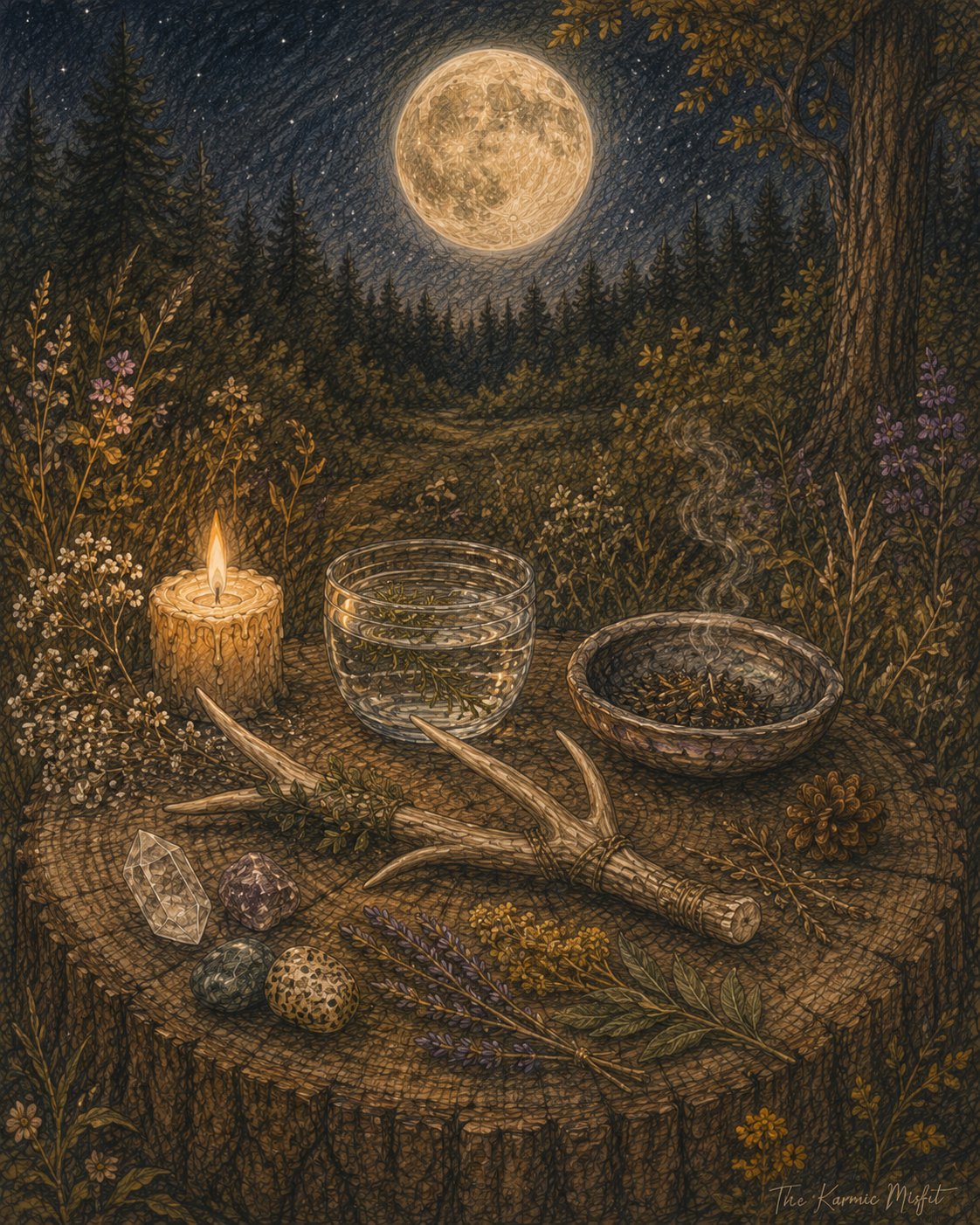
The Buck Moon is deeply connected to nature, instinct, and steady transformation, so the tools used in this ritual are intentionally earthy and simple. You do not need to gather every item perfectly or purchase anything elaborate. Use what you already have whenever possible, and allow the meaning behind each object to matter more than its appearance.
You will need:
- A fallen twig or small branch to represent the antler, your strength, and the growth you have already experienced
- A candle in white, green, brown, gold, or another color that feels connected to renewal and personal power
- A small piece of paper and a pen for writing what you are ready to shed
- Natural string, twine, or ribbon to tie the paper to the twig
- A bowl of moon water or fresh water for cleansing and anointing
- A fire-safe bowl or dish if you plan to burn the paper
- Herbs, leaves, flowers, stones, or other natural objects to decorate your space and help you feel connected to the season
- A journal, if you would like to record what comes forward during the ritual
The twig is the heart of this ceremony. Choose one that has already fallen naturally rather than breaking it from a living tree. It does not need to resemble an antler perfectly. A slightly curved or branching piece may feel especially symbolic, but any small twig that draws your attention can be used. Sometimes the object that quietly catches your eye is the one meant to become part of the ritual.
Your candle serves as the guiding flame of the ceremony. It represents awareness, transformation, and the light you are bringing to the parts of yourself that are ready to change. The paper will hold the words, patterns, fears, or identities you are releasing, while the string temporarily binds them to the symbolic antler. Later, when the string is untied or the paper is burned, that bond is intentionally broken.
The water will be used near the end of the ritual to cleanse and bless the twin after the release has taken place. Moon water can add a meaningful lunar connection, but ordinary water is perfectly acceptable. You may also place a sprig of rosemary, cedar, lavender, or another personally significant herb in the bowl before beginning.
Allow the rest of your materials to reflect your own practice. You may choose moss, wildflowers, feathers, stones, crystals, bark, or a bowl of soil. There is no single correct arrangement. The goal is to create a space that feels grounded, safe, and connected to the natural cycle of growth and release.
Preparing Your Sacred Space

Before beginning the ritual, take a few moments to create a space where you can be fully present. This does not need to be an elaborate altar or a perfectly arranged setting. It simply needs to feel intentional, peaceful, and separate from the distractions of everyday life. The purpose of preparing the space is to signal your mind, body, and spirit that you are stepping into a moment of reflection.
If possible, perform this ritual outdoors beneath the Buck Moon, surrounded by the sounds of energy of the natural world. A quiet place in your yard, garden, porch, or near an open window can work beautifully. You do not need a clear view of the moon for the ritual to be meaningful. Its energy is still present even when clouds, trees, or walls stand between you and the night sky.
Arrange your materials in a way that feels natural to you. Place the candle near the center, with the twig resting beside it. Set the bowl of water and fire-safe dish within easy reach. You may scatter leaves, herbs, flowers, stones, or other natural items around the space to represent the fullness of the season. There is no need for perfect symmetry. Let the altar feel alive, earthy, and personal.
Once everything is in place, take a moment to settle yourself. Silence your phone, lower the lights, and allow the outside world to soften. Sit comfortably and take several slow breaths. With each inhale, imagine yourself drawing in steadiness. With each exhale, release the tension you have been carrying throughout the day.
You may cleanse the space in whatever way feels right for your practice. This could include smoke from incense or herbs, the sound of a bell, a light mist of moon water, or simply moving your hands around the area while setting the intention that the space is protected and clear. Cleansing does not need to be complicated. Even a few quiet words can be enough:
I clear this space of heaviness and distraction. May only truth, growth, and gentle transformation enter here.
When you feel ready, hold the twig in your hands. Notice its shape, texture, knots, and imperfections. Remember that it once grew as part of something living before naturally falling away. Let it become a symbol of strength you have developed, the seasons you have survived, and the parts of yourself that are now ready to change.
Place the twig back beside the candle. Take one final breath before lighting the flame, allowing yourself to arrive fully in the ritual.
Honoring the Strength You have Grown

Before asking yourself what you are ready to release, begin by recognizing what has already grown within you. Shedding is not meant to erase the path behind you. It is meant to honor the strength that was built along the way.
Light the candle and watch the flame for a few quiet moments. Allow your breathing slow as you settle into the space. Then take the twig into your hands and think about the season of life you have recently moved through. Consider the challenges you faced, the choices you made, and the ways you continued forward even when growth felt slow or invisible.
You may ask yourself:
- What have I survived that once felt impossible?
- What have I earned about myself?
- Where have I become stronger, wiser, or more honest?
- What part of me deserves to be acknowledged tonight?
Do not dismiss your growth simply because it did not look dramatic. Strength can appear in many forms. It may be found in setting a boundary, asking for help, choosing rest, walking away, starting over, remaining sober, speaking truth, or simply continuing through a difficult season. Some of the most important growth happens quietly, where no one else can see it.
When one quality or accomplishment comes to mind, say it aloud or whisper it into the space. You may speak freely, or use words such as:
I honor the strength I have grown through all that I have faced. I honor the lessons that shaped me, the courage that carried me, and the person I became along the way.
Hold the twig near the candlelight without placing it close enough to burn. Imagine the flame illuminating every bend, mark, and rough edge. Let those imperfections remind you that growth does not need to be flawless to be sacred.
You may write the quality you are honoring in your journal or on a separate piece of paper to keep. Choose a word such as courage, patience, resilience, honesty, discipline, softness, or self-trust. Let this word become the foundation of the ritual. You are not releasing everything you have been. You are carrying this strength forward.
When you feel ready, place the twig back in front of you. Take a breath and thank the version of yourself who made it this far. The next part of the ritual will ask you to release what has completed its purpose, but first, allow yourself to feel proud and of what remains.
The Antler Shedding Ceremony

Now that you have honored the strength you are carrying forward, turn your attention toward what has completed its purpose. This may be a fear, habit, belief, attachment, role, expectation, or version of yourself that no longer belongs in the life you are creating. Try not to choose what you think you should release. Instead, listen for what has already begun to feel heavy, restrictive, or out of alignment.
Take the small piece of paper and write down what you are ready to shed. You may name it with a single word, write a short sentence, or describe it more fully. Be honest, but gentle with yourself. The purpose is not to judge the part of you that carried this weight. It is to recognize that its season may not be coming to an end.
As you write, consider:
- What am I carrying out of habit rather than necessity?
- What once protected me but now keeps me small?
- What belief about myself am I ready to question?
- What am I afraid will happen if I finally let this go?
- Who might I become without this weight?
When you are finished, fold the paper toward you once in acknowledgment of the lesson it brought. Then fold it away from you to represent your willingness to release it. Hold the folded paper between your palms and take a slow breath.
You may say:
I honor the purpose you once served. I honor the lessons you leave behind. Your season within me is complete, and I release you without hatred, shame, or fear.
Place the folded paper against the twig and wrap the string around both. Tie it securely, but do not make the knot impossible to undo. The tied paper represents the way we can become attached to old patterns, even after we have outgrown them. Sometimes we continue carrying something simply because it has been part of us for so long.
Hold the bound twig in your hands and close your eyes. Imagine it is an antler at the end of its cycle – once necessary, once strong, but now ready to fall away. Allow any emotions that arise to be present. Release can bring relief, sadness, fear, gratitude, or even uncertainty. You do not need to force yourself to feel peaceful. Simply remain honest with the moment.
When you are ready, slowly untie the string. As it loosens, imagine the attachment between you and what you wrote beginning to soften. Remove the paper from the twig and place the string aside. Notice that the twig remains in your hands. Your strength remains. Your experience remains. Only the burden is being released.
If it is safe and permitted where you are, place the paper in at the fire-safe bowl and light one corner using the candle. Never hold the paper while it burns, and keep water nearby. Watch as the words curl, darken, and turn to ash. You may say:
As this form changes, so does my relationship with what I have carried. I release what is finished. I make room for what is becoming.
If burning is not safe or uncomfortable, tear the paper into small pieces instead. You may soak them in water until the words blur, bury biodegradable paper in the earth, or dispose of it away from your ritual space. The intention behind the release matters more than the method.
Remain still for a few moments after the paper is gone. You may not feel immediately different, and that is perfectly all right. Ritual does not erase every pattern in a single night. It marks a conscious decision. It becomes a point you can return to when the old weight tries to settle onto your shoulders again.
Look at the twig once more. It is not longer bound to what you released. Let it remind you that shedding does not remove your strength. It reveals what was underneath all along.
Anointing the New Growth

After the shedding comes the space left behind. This emptiness is not something to fear or rush to fill. It is fertile ground. It is the quiet place where a new intention can begin to take root before it is fully visible.
Take the bowl of moon water or fresh water and place it in front of you. If you added herbs to the water, gently stir them with your fingers or allow them to rest on the surface. Hold the twig above the bowl and think about what you would like to grow in the place of what you released.
Try to choose an intention that feels honest and possible. Rather than asking yourself to become an entirely different person, focus on one quality, habit, or way of moving through life that you want to strengthen. This may be courage, peace, self-trust, patience, discipline, creativity, softness, confidence, or the ability to set stronger boundaries.
You may ask yourself:
- What do I want to make room for now?
- What quality will support the person I am becoming?
- How do I want to respond differently moving forward?
- What small action would help this new growth take shape?
Dip your fingertips into the water and lightly touch the twig. You may trace along its branches, knots, or natural curves as though blessing each part of it. As you do, imagine the water washing away the final residue of what was released and awakening the intention you have chosen.
Speak your intention aloud in a clear and simple way. You may say:
Where I have shed, I now create space. Where I have released, I now welcome growth. May this new season strengthen what is true, steady, and alive within me.
You may also name your specific intention:
I welcome deeper self-trust.
I grow stronger in my boundaries.
I choose peace without abandoning my power.
I allow myself to begin again.
Continue anointing the twig until the words feel settled. There is no need to repeat the affirmation a certain number of times or wait for a dramatic sign. The act itself is enough. You are giving shape to a decision and creating a physical reminder of the growth you want to nurture.
When you are finished, hold the twig upright for a moment. Imagine it no longer as something shed, but as the beginning of a new set of antlers slowly forming. Your intention may still feel tender, uncertain, or unfinished. That does not make it weak. New growth often begins softly before it becomes strong enough to carry weight.
Place the twig by the candle and allow it to dry. Let it remain there for the rest of the ritual as a symbol of the space you have cleared and the direction you have chosen.
Sitting Beneath the Buck Moon

Once the twig has been anointed and placed beside the candle, allow yourself to become still. The active part of the ritual is complete. Nothing more needs to be forced, solved, or understood in this moment. This is the time to simply sit with what you have released and what you have chosen to grow.
Turn your attention toward the moon, whether you can see it clearly or only sense its presence beyond the clouds or walls around you. Let its light become a reminder that growth continues even when it is not visible. The moon does not remain full forever, yet its fullness is never lost. It moves through phases, gathers itself, disappears from view, and returns again. Your own growth may move in the same way.
Take several slow breaths and notice how your body feels. You may feel lighter, emotional, tired, peaceful, uncertain, or unchanged. There is no correct response. A meaningful ritual does not always create an immediate sense of transformation. Sometimes the shift begins quietly and reveals itself later through a new choice, a clearer boundary, or a moment when you realize the old weight no longer holds the same power.
You may place one hand over your heart and the other on the earth, floor, or surface beneath you. Feel yourself supported by what is steady. Imagine roots extending downward from your body, grounding you while the moonlight rests above. You are held between earth and sky, between what has ended and what is begining.
Remain here for as long as feels right. You may journal, meditate, listen to the night around you, or simply watch the candle flame move. Try not to fill the stillness too quickly. Let the quiet become part of the ritual.
When you are ready, speak your intention once more:
I trust the growth I cannot yet see. I release what has finished, honor what has strengthened me, and welcome what is ready to begin.
Allow the words to settle without needing proof that everything has changed. The ritual has marked your choice. The rest will be carried forward though the way you tend to that intention in the days and weeks ahead.
Closing the Ritual

When you feel ready to close, bring your attnetion back to the candle, the twig, and the space around you. Take a moment to notice what has shifted, even if that change feels subtle. You have honored strength that brought you here, named what you are ready to shed, and chosen what you want to grow in its place. That is enough for tonight.
Place both hands around the twig one final time. Let it become a reminder that you are not leaving this ritual empty-handed. You are carrying forward the wisdom, resilience, and self-awareness that came from the season behind you. What was released does not erase your history. It simply loosens its hold on the person you are becoming.
You may close with these words:
Beneath the Buck Moon, I honor what has shaped me, release what has competed its purpose, and welcome the strength still growing within me. May I move forward with courage, patience, and trust in the path unfolding before me.
Thank the moon, the earth, your spiritual guides, ancestors, deities, or your own inner wisdom in whatever way feels most natural to your practice. If you opened or cleansed the space with specific words, you may now speak a simple closing such as:
This ritual is complete. The lesson remains, the burden is released, and this space is returned to peace.
Extinguish the candle safely rather than leaving it unattended. Some practitioners prefer to snuff the flame instead of blowing out, but either method is perfectly acceptable. Choose what feels right and are for you.
You may keep the anointed twig on your altar, desk, windowsill, or somewhere you will see it regularly throughout the next moon cycle. Each time you notice it, return the intention you placed within it and ask yourself whether your daily choices are supporting that growth. When the intention feels fully rooted, you can return the twig to the earth with gratitude.
Dispose of any ashes responsibly once they are completely cool. They may be scattered outdoors, buried in the soil, or discarded away from your sacred space. If you used another method of release, complete it with the same care and intention.
In the days that follow, remember that shedding is rarely a single moment. Old habits, fears, and beliefs may return, asking to be carried again. When they do, think back to the untied string and the unbound twig. You are allowed to release the same weight more than once. Growth is not made less sacred because it takes practice.
The Buck Moon reminds us that strength is not only found in what we build. It is also found in knowing when to let something fall away. Trust the space you have created, tend gently to what you have chosen to grow, and allow your next season to unfold in its own time.

Leave a Reply