There are moments in life that do not seem significant while we are living them. We are too busy surviving, deciding, adjusting, or simply trying to make it through whatever is in front of us. A move may feel just like a move. A street may be nothing more than an address. A detour may feel like an inconvenience, and a crossroads may look like nothing more than a difficult decision. Then, sometimes years later, something shifts. We look back with a little more distance, a little more understanding, and realize the road carried meaning we could not see at the time.
I have been thinking about this a lot lately because of something that seems so simple on the surface. For years, I have lived on a street called Traverse. I knew the name, of course, but I never really stopped to think about what it meant. It was simply where I lived. Then recently, while reflecting on everything that brought me here and everything that has happened since, the word suddenly felt different. Traverse means to travel across, move through, or pass over something. When I considered the path that led me here, the version of myself who first arrived, and the person I have slowly become while living here, that meaning landed in a completley different way.
Sometimes we do not recognize the symbolism of a place until we have lived enough of the story to understand it. What once seemed random can begin to feel strangely meaningful when we look back and see how many pieces had to fall into place. A home that once felt temporary may become the place where we rebuild ourselves. A street we barely noticed may take a deeper meaning. A difficult turn in life may eventually reveal itself as the exact detour that led us somewhere we needed to be.
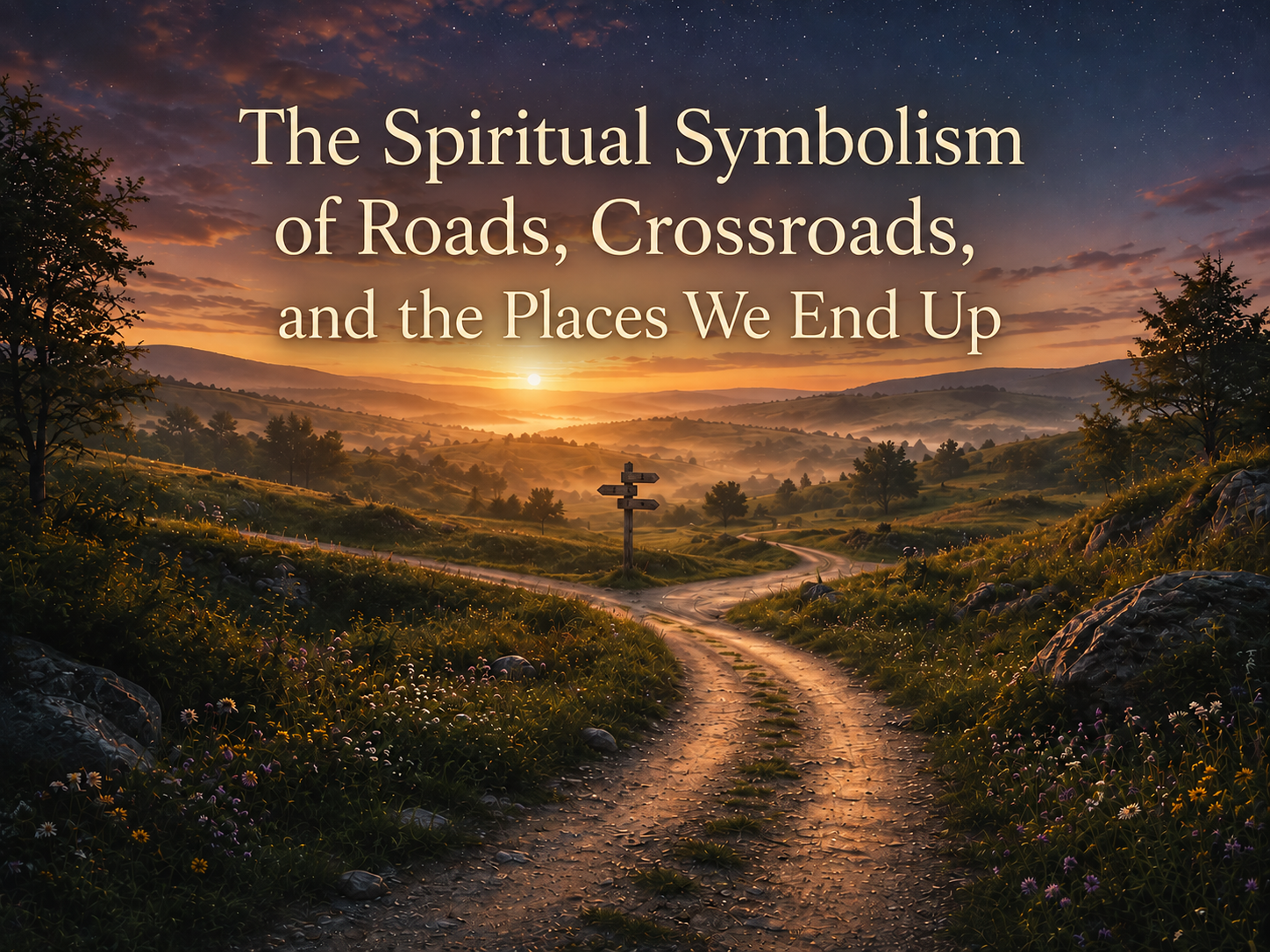
Roads have always carried powerful symbolism because they naturally mirror the human experience. They represent movement, choice, transition, distance, direction, and the unknown. We speak about life itself as a journey. We talk about being on the right path, losing our way, watching a crossroads, taking a detour, turning back, starting over, or finally finding our way home. These expressions are so familiar that we rarely stop to consider just how deeply the image of a road is woven into the way we understand growth and change.
There is something almost sacred about that symbolism. A road connects one place to another, but on a deeper level it can also represent the space between who we were and who we are becoming. Some roads are chosen deliberately because we know exactly where we want to go. Others appear because circumstances leave us with very little choice. Some lead exactly where we expected, while others take us through unfamiliar territory and bring us places we never could have planned for ourselves.
That is where the mystery begins.
Whether we view these moments as coincidence, synchronicity, divine timing, intuition, fate, or simply the human tendency to find the meaning in our experiences, there are certain places and moments that seem to speak more clearly in hindsight. A street name suddenly feels like a message. A destination becomes part of our transformation. A detour we once resented becomes the very thing that changed the direction of our lives. What felt like an ending at the time may eventually reveal itself as the beginning of an entirely different path.
We may not always understand the road while we are walking it, and perhaps we are not supposed to. Sometimes all we can do is keep moving, crossing one invisible threshold after another without knowing exactly where it is leading. Then one day, we are given enough distance to turn around and see the journey differently. We notice how far we have traveled, what we survived along the way, what we left behind, and what quietly began to grow in its place.
Maybe that is one of the deeper lessons roads offer us: not every path makes sense at the beginning. Some only reveal their meaning after we have traveled far enough to recognize the person we became along the way.
Roads as Symbols of the Life Journey

Roads are one of the oldest and most universal symbols of the human experience because nearly everyone understands what it means to move from one place to another. Even when we are not speaking literally, we use the language of roads to describe our lives. We say we are finding our path, changing direction, moving forward, going through a rough stretch, or trying to figure out where we are headed. The image of a road becomes a natural way to understand growth because life itself is rarely stationary.
A road can represent possibility, but it can also represent uncertainty. When we stand at the beginning of a path, we usually cannot see everything waiting ahead. We may know the direction we want to travel, but we cannot always predict the obstacles, delays, unexpected turns, or people we will meet along the way. In that sense, roads reflect the way we move through life. We make decisions with the information we have in the moment, often without knowing how important those choices will become later.
There is also something deeply symbolic about tthe fact that roads connect places that would otherwise remain separate. They carry us from what is familiar into what is unknown. They can take us away from homes, relationships, beliefs, routines, or versions of ourselves that once felt permanent. At the same time, they can lead us toward opportunities, healing, relationships, and parts of ourselves we had not yet discovered.
Not every road is smooth, either. Some are winding, damaged, steep, or difficult to follow. Some require us to slow down, turn around, and ask for directions, or choose another route entirely. Those moments can feel frustrating while we are inside them, but they often mirror the more difficult periods of life. Progress does not always look like moving quickly in a straight line. Sometimes progress looks like taking the long way, resting when necessary, or admitting that the direction we were headed no longer feels right.
Detours carry their own symbolism as well. A detour usually appears when the road we intended to take is no longer available, and that can be unsettling. We may feel inconvenienced, delayed, or even angry that our plans have been interrupted. Yet some of the most meaningful changes in life begin exactly that way. We are redirected by circumstances we did not choose, only to discover later that the unexpected route introduced us to something, someone, or some version of ourselves we may never have encountered otherwise.
The road behind us matters just as much as the one ahead. Looking back can reveal patterns that were invisible when we were focused only on getting through the next day. We may finally understand why certain endings were necessary, why particular relationships faded, or why something that once felt like failure actually created room for a different life to begin. Hindsight does not erase the difficulty of what we experienced, but it can give those experiences a different shape.
Perhaps that is why roads remain such powerful symbols. They remind us that movement does not aways require certainty. We can continue forward without having every answer, and we can change direction without believing we have failed. A road is not valuable only because of where it ends. Its meaning is also found in everything we encounter, release, learn, and become while traveling it.
The Meaning of Crossroads

If roads represent the journey itself, crossroads represents the moments when that journey asks something of us. They are places of decision, uncertainty, possibility, and change. A crossroads appear when the path ahead is no longer singular, when more than one direction becomes possible and we are forced to consider what comes next. Sometimes the choice is obvious. Other times, every direction seems to carry its own risk, promise, and unknown.
This is part of why crossroads have held such a powerful symbolism throughout history, folklore, and spiritual traditions. They exist between destinations, making them what is often called a liminal space – a threshold between what has been and what has not yet fully begun. At a crossroads, we are not quite where we came from anymore, but we have not yet arrived at wherever we are going. That in-between quality can feel uncomfortable, but it can be deeply transformative.
In our own lives, crossroads rarely announce themselves with dramatic signs. Sometimes they arrive quietly. A relationship no longer feels the same. A job begins to drain more than it gives. A dream we once wanted starts to feel like it belongs to an older version of ourselves. We may sense that something needs to change long before we know exactly what that change should look like. These moments can create restlessness because part of us is still attached to what is familiar while another part is already reaching toward something different.
Crossroads can also appear after an ending. Loss, disappointment, relocation, separation, or sudden change can place us somewhere we never expected to stand. In those moments, we may not feel as though we are choosing a new path at all. We may imply be trying to figure out how to continue. Yet even an unwanted crossroads can eventually become a place where new direction begins to take shape.
There is a certain kind of courage required at a crossroads because choosing one path often means leaving another unexplored. We cannot always know whether we are making the “right” decision, and that uncertainty can make us hesitate. We may wish for a clear sign, a perfect answer, or some guarantee that the direction we choose will lead somewhere good. Life rarely gives us that kind of certainty. More often, we choose based on what we know, what we feel, what we have learned, and what we are no longer willing to carry with us.
Spiritually, crossroads can be viewed as moments of deep personal agency. They remind us that while we cannot control every circumstance that brings us to a particular point, we often have some say in what we do once we arrive there. We can repeat familiar patterns, remain where we are, turn back, or take a direction we have never tried before. Even when our options are limited, the crossroads still asks us to become conscious of the choice in front of us.
Sometimes the most important choice is not about where we are going at all. Sometimes it is about who we are willing to become as we move forward. A crossroads can ask us to choose between fear and trust, familiarity and growth, silence and honest, resentment and release, or the person we have always been and the person we sense we are becoming.
That is what makes crossroads so powerful. They are not only intersections on a road; they are symbolic moments when the course of our lives can shift. We may not recognize their importance while standing in the middle of them, but years later, we can often look back and see the exact moment when one path ended, another opened, and something within us quietly chose to keep going.
The Places We End Up

Not every important place in our lives is somewhere we deliberately choose. Sometimes we arrive because of necessity, timing, cirumstance, or a chain of events we could never have planned. A temporary stop becomes a home. A town we never imagined living in becomes part of our identity. A place we once viewed as merely practical becomes the backdrop of some of our deepest growth.
There is something powerful about the places that hold us during periods of transition. They become witnesses to who we were then we arrived and who we slowly become while living there. A room can hold the memory of sleepless nights and difficult decisions. A porch can become the place where we finally started breathing a little easier. A garden, a street, or even a familiar route to the store can become connected to a chapter of our lives in ways we may not fully understand until much later.
This is why certain places can feel almost symbolic when we look back on them. They become more than coordinates on a map. They are connected to healing, endings, new beginnings, grief, creativity, love, survival, or transformation. We may remember exactly how we felt when we first arrived there, and years later, realize how different we were when we eventually looked around and recognized that the place had become part of us.
Sometimes the places we end up are not beautiful or easy in the beginning. They may arrive during some of the hardest seasons of our lives. We may enter them exhausted, uncertain, or simply grateful to have somewhere to land. At the time, we are rarely thinking about symbolism or destiny. We are thinking about what needs to happen next. Only after life settles to we sometimes begin to notice how much changed within us while we were there.
There can be a strange kind of magic in that realization. A place we never would have chosen under different circumstances may become exactly where we needed enough stillness to hear ourselves again. It may become exactly where we needed enough stillness to hear ourselves again. It may be where we reconnect with creativity, spirituality, nature, or some forgotten part of ourselves. The place itself does not have tone perfect to become meaningful. Sometimes its importance comes from what it gave us room to become.
We also leave pieces of ourselves in the places we inhabit. The version of us who first walked through the door does not always leave in the same form. We change the space, and in subtle ways, the space changes us. We fill rooms with our belongings, routines, memories, rituals, losses, hopes, and plans. Over time, a location can become intertwined with the story of a particular version of ourselves.
This does not necessarily mean every destination was predetermined or that every difficult experience happened for a reason. Sometimes circumstances are simply difficult, unfair, or unexpected. But even without knowing why something happened, we can still recognize it what grew from it. Meaning does not always require explanation. Sometimes it comes from noticing what a particular chapter taught us, what it helped us leave behind, and what becomes possible once we arrive on the other side.
Perhaps that is why certain places remain emotionally significant long after we leave them. They remind us of a threshold we crossed without realizing it at the time. We may remember them as the place where something needed, where something awakened, or where we quietly begin becoming someone new.
The places we end up are not always the places we imagined for ourselves. Sometimes, however, they become the places where we finally discover that the journey was asking us to learn.
Coincidence, Synchronicity, or Something More?

I am a firm believer that there is no such thing as coincidence. I believe things cross our path for a reason, even when we do not understand that reason right away. Sometimes it is a person, a place, a word, a number, a symbol, a conversation, or a moment that seems almost too perfectly timed to ignore. These experiences may look ordinary from the outside, but when they happen at exactly the right point in our lives, they can feel like something much deeper is at work.
To me, synchronicity is one of the ways life speaks to us. It does not always arrive as some enourmous, undeniable sign. More often, it is subtle. It may be hearing the same message several times while wrestling with a difficult question, thinking about someone just before they reach out, repeatedly seeing a symbol that connects directly to something we are moving through, or realizing later that a place or name held meaning we could not yet see. I do not view those moments as random. I see them as little points of connection woven throughout our lives.
We are often shown things before we are ready to fully understand them. The meaning may already be there, but we may not yet have the perspective to recognize it. We are still living the story, still moving through the lesson, and still becoming the person who willl eventually look back and understand why a certain moment mattered. In that sense, synchronicity is not always about receiving an immediate answer. Sometimes it is simply a quiet reminder to pay attention.
These moments often seem to become more noticeable during periods of change. When we are moving through endings, beginnings, spiritual growth, grief, healing, or major transitions, certain things can suddenly stand out more clearly. A phrase hits differently. A song appears at the exact right time. A stranger says something that stays with us. A road, a name, or a place begins to carry meaning it never seemed to have before. For me, those moments are not coincidence. They are connection.
Our lives are filled with threads that we cannot always see until enough time has passed to notice how they weave together. One event leads to another. One ending makes room for a beginning. One unexpected turn carries us somewhere we never planned to go, only for us to discover later that the detour became part of something much larger. What feels disconnected in the moment can sometimes make perfect sense in hindsight.
That does not mean you will always understand every sign when it appears. Most of the time, I don’t, and I think that is part of the experience. We are not always meant to receive the full explanation in the moment. Sometimes we are only meant to notice, remember, and keep moving. Then, later, something clicks. We look back at a person we met, a place we ended up, a decision we made, or a symbol that kept appearing, and suddenly the pieces connect in a way they did not before.
Those are the moments that remind me why I believe there are no coincidences. Sometimes the meaning is there long before we are ready to recognize it, quietly waiting for us to reach the point in the journey where we can finally understand what it was trying to show us.
When a Name Becomes a Message

Sometimes a word is simply a word until life gives it context. We can see a name every day, say it without thinking, write it on envelopes, type it into directions, and never once stop to consider what it means. Then one day, something shifts. We look at that same word through the lens of everything we have lived through, and suddenly it feels as though it has been quietly waiting for us to notice it.
That is what happened to me with the word Traverse.
For years, it was simply the name of the street where I lived. I never gave it much thought beyond that. But recently, as I reflected on the path that brought me here and the person I have become since arriving, the meaning of the word stood out to me in a completely different way. Traverse means to cross, travel through, or move across something. It speaks of movement, passage, distance, and making your way from one side to another.
When I thought about that meaning in relation to my own life, it felt strangely fitting. I had not arrived here during a simple or easy chapter. I was moving through uncertainty, instability, and a version of my life that was falling apart faster than I could rebuild it. At the time, I was not looking for symbolism. I was trying to survive the circumstances in front of me and figure out where I was going next. The deeper meaning of the place was invisible to me because I was still in the middle of crossing through it.
Years later, I can see the contrast more clearly. The person who first came to this place is not the same person writing these words now. There has been growth, healing, creativity, spiritual exploration, and a gradual rebuilding of the self. None of it happened overnight, and none of it followed a perfectly straight path. It happened slowly, through small choices, difficult realizations, quiet changes, and the decision to keep moving even when I did not know exactly where I was going.
That is what makes the word Traverse feel so meaningful to me now. It does not imply that the journey was easy. To traverse something is to move through it. You do not disappear from one side and magically appear on the other. There is a distance between the two points. There is terrain to cross, uncertainty to navigate, and often a part of yourself that must change along the way.
Maybe that is why certain names, places, and symbols seem to reveal themselves only after time has passed. Their meaning depends on the story that unfolds around them. A street name that once meant nothing can become a reminder of everything you crossed to get where you are. A place you landed unexpectedly can become a marker between one chapter of your life and another.
I cannot say with certainty why I ended up on a street called Traverse, and I do not think I need to. For me, the beauty is in recognizing the connection now. Whether it was coincidence, synchronicity, fate, or simply a meaning I was finally ready to see, the word has become part of how I understand this chapter of my life.
Sometimes the message is not something that predicts where we are going. Sometimes it simply names what we have already done.
I came here without knowing what this place would become for me. Looking back now, I realize just how much of my life I have traversed while living here.
You May Not Understand the Road While You’re Walking It

One of the hardest parts of any journey is not knowing what it will mean while we are still inside it. When life is uncertain, painful, or changing quickly, we usually do not have the luxury of seeing the bigger picture. We are focused on the immediate moment, the next decision, the next problem, or simply getting through the day. Meaning often comes later, after we have enough distance to see the shape of what we survived.
This is why difficult chapters can feel so confusing while they are happening. We may wonder why something ended, why a plan fell apart, why we were redirected or why we had to take a path we never would have chosen for ourselves. In the middle of those moments, it can feel as though nothing makes sense. We may feel lost, stalled, or even convinced that we have somehow gone backward.
But a road does not stop being a road just because we cannot see where it leads.
There are stretches of life where progress is almost invisible. We may be healing in ways we cannot yet recognize, learning boundaries we never had before, becoming more aware of what we will and will not accept, or quietly building a life that fits us better. These changes rarely happen all at once. More often, they happen through repetition, reflection, mistakes, small decisions, and the gradual release of what no longer belongs.
Sometimes we only realize how much we have changed when we encounter something that would have once pulled us back into an old pattern and notice where we once would have stayed silent. We walk away from what once felt impossible to leave. We begin trusting ourselves in places where we used to need constant reassurance. These moments reveal that the journey was doing something within us, even when we thought we were standing still.
There is also a tendency to believe that if we cannot understand a difficult experience, then it must have been meaningless. But not every chapter needs a neat explanation. Some hints may never make complete sense, and we do not have to force them into a lesson in order to move forward. Sometimes the meaning comes from what we choose to do afterword rather than why the experience happened in the first place.
That distinction can be freeing. It allows us to honor what was painful without pretneding it was necessary. We can acknowledge that something hurt us and still recognize the strength, clarity, compassion, or wisdom we developed as we found our way through it. Growth does not erase the past, but it can change the way we carry it.
Looking back can also help us see how many times we thought we were lost when we were actually in transition. The path may have been unfamiliar, but unfamiliar does not aways mean wrong. Sometimes it simply means we have moved beyond the map we used to follow.
Perhaps that is the deeper lesson of the road: we are not required to understand every mile as we travel it. We are allowed to be uncertain. We are allowed to change direction. We are allowed to stop, rest, reconsider, and begin again. The journey does not become less meaningful because we could not explain it at the time.
Sometimes understanding arrives only after we have crossed enough distance to look back and recognize that the road was changing us long before we knew where it was taking us.
A Simple Crossroads Reflection Ritual

There are times when we know we are standing at a crossroads even if nothing around us has visibly changed. We may feel restless, uncertain, drawn toaward something new, or aware that an old chapter is beginning to close. In moments like these, a simple reflection ritual can help create space to listen to ourselves without forcing an immediate answer.
This does not need to be elaborate. You can keep it as simple as a candle, a journal, and a quiet place where you will not be interrupted. If you would like to make it feel more symbolic, you can also place a small stone, key, piece of twine, or other objects beside you to represent the path ahead. The purpose is not to predict the future or demand a sign. It is simply to become more intentional about where you are, what you are carrying, and what you may be ready to move toward.
Begin by lighting the candle and taking a few quiet moments to settle into the space. Think about the road behind you first. Consider what this current chapter has taught you, what you have survived, and what no longer feels aligned with the person you are becoming. You may want to write freely for a few minutes without worrying about whether your thoughts sound polished or profound.
Then turn your attention toward the crossroads in front of you. Ask yourself: What am I ready to leave behind? What am I being asked to carry forward? What direction feels more honest, even if it feels unfamiliar? What would I choose if I trusted myself a little more?
You do not need to answer every question perfectly. Sometimes one word, feeling, image, or thought is enough. The goal is not certainty. It is awareness.
If you are using a small object, hold it in your hand once you have finished writing. Let it represent the choice to keep moving with intention, even if you do not yet know exactly where the road will lead. You might keep it on your altar, desk, nightstand, or somewhere you will see it as a reminder that being at a crossroads does not mean you are lost. It simply means more than one direction is possible.
When you are ready to close, extinguish the candle and thank yourself for taking the time to listen inward. You do not have to make a major decision that same day. Sometimes clarity arrives slowly, after we have given ourselves enough quiet to recognize what we already know.
Crossroads are not always meant to be rushed through. Sometimes they are invitations to become still long enough to notice which path feels most like your own.
Closing: Keep Walking

There is something deeply human about wanting to know where the road leads before we take the next step. We want reassurance that the choice will be worth it, that the detour will make sense, and that the difficult parts will eventually reveal a purpose. But life rarely gives us that kind go uncertainty. More often, we are asked to move forward with only pieces of the map.
That does not mean we are moving without meaning.
Every road we have traveled has shaped us in some way. Some taught us what we wanted. Others showed us what we could no longer accept. Some led us toward people, places, and experiences that changed us. Others simply taught us how much strength it takes to leave something behind and keep going.
The same is true of crossroads. We may not always recognize them in the moment, but they often become the places we remember most clearly in hindsight. They mark the points where something shifted, where one direction ended, and where another quietly began. Sometimes the most important thing about crossroads is not whether we made the perfect choice. It is that we chose to keep moving.
And then there are places we end up.
Some become temporary shelters. Some become homes. Some become chapters we outgrow, and some become sacred simply because of what happened within us while we were there. A place does not have to be extraordinary to become meaningful. Sometimes its significance lies in the version of ourselves that was born there.
That is what I have come to understand about my own relationship with the word Traverse. What once felt like nothing more than a street name now feels like a quiet reflection of everything I have moved through. I did not understand that meaning when I first arrived. I understand it now because I have lived enough of the story to see it.
Maybe that is how some signs work. They do not always arrive as instructions or warnings. Sometimes they simply wait beside us until we are ready to understand them.
So if you are standing at a crossroads, moving through an uncertain chapter, or wondering whether the road you are on is taking you anywhere at all, remember that not every path reveals itself at the beginning. Some meanings only become visible after we have traveled far enough to look back.
You do not need to have every answer before you move forward. You only need the willingness to take the next step, trust what you are learning, and stay open to the possibility that the road may make more sense later.
Keep walking. One day, may you turn around and realize that once felt like wandering was actually your way through.

Leave a Reply